When people think of Tokyo’s skyline, they often think about famous landmarks like Tokyo Skytree or Tokyo Tower. Both are beautiful in their own ways, and they charge admission fees for the breathtaking views they offer. Nestled in the heart of Shinjuku is the Tokyo …
Tokyo is a city where modern skyscrapers, futuristic train stations, and ramen shops coexist with ancient shrines & temples that seem to whisper history in every wooden beam. Among these, Yasukuni Jinja Shrine stands out. It stands out not only for its serene beauty but …
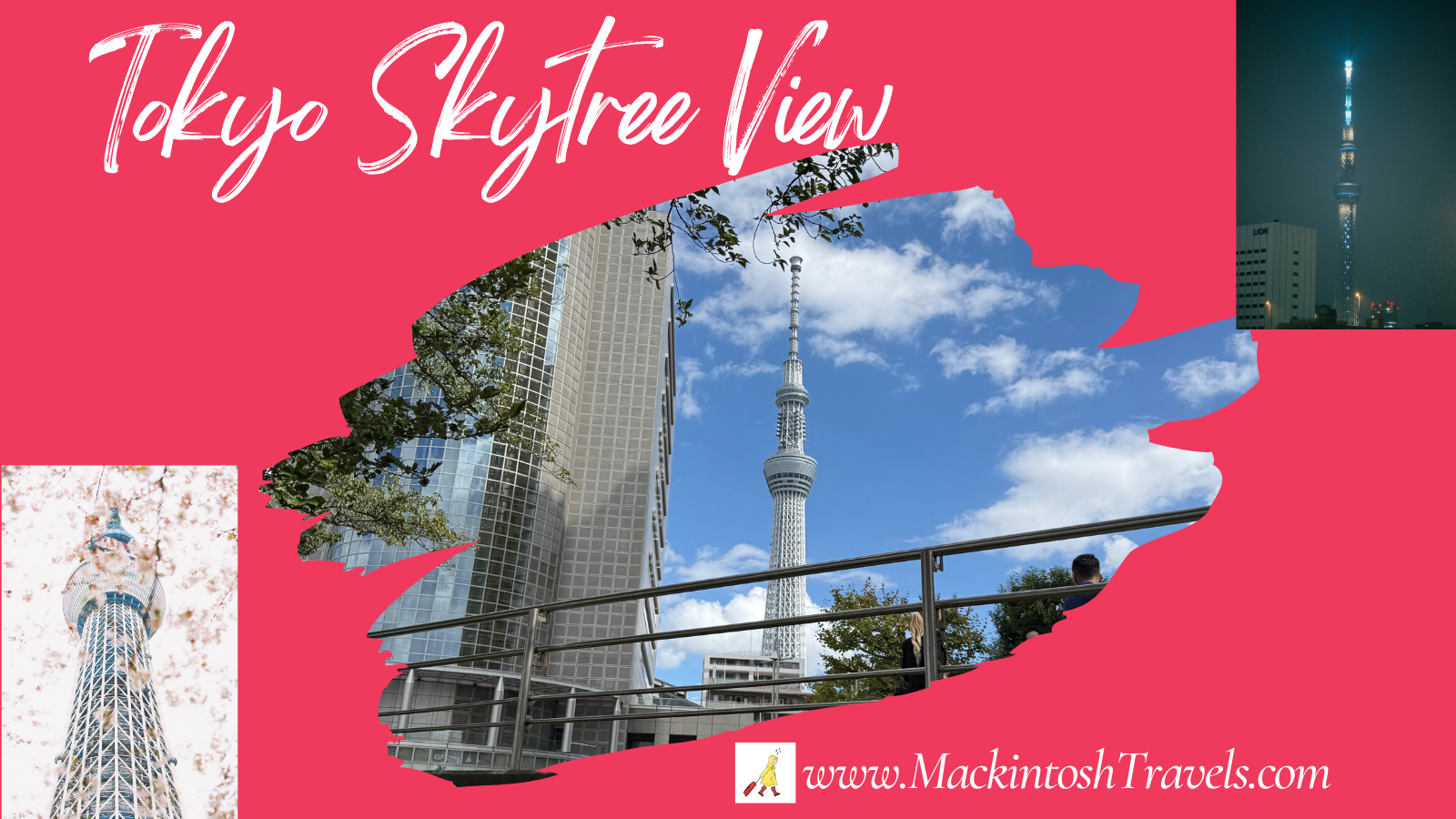
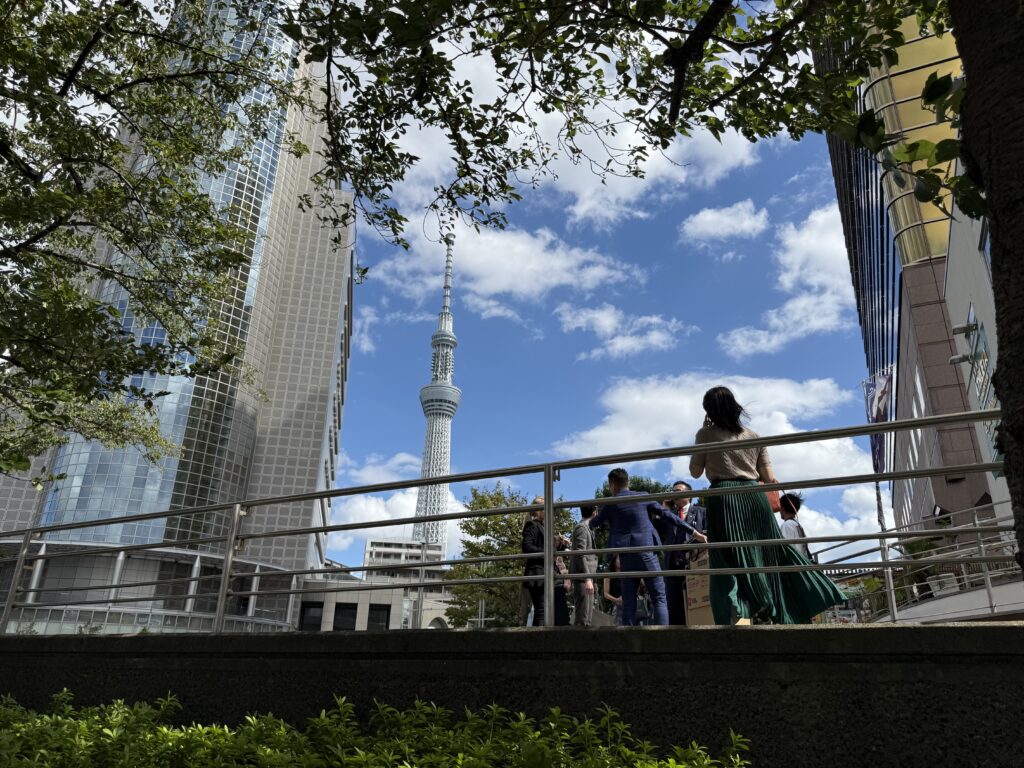
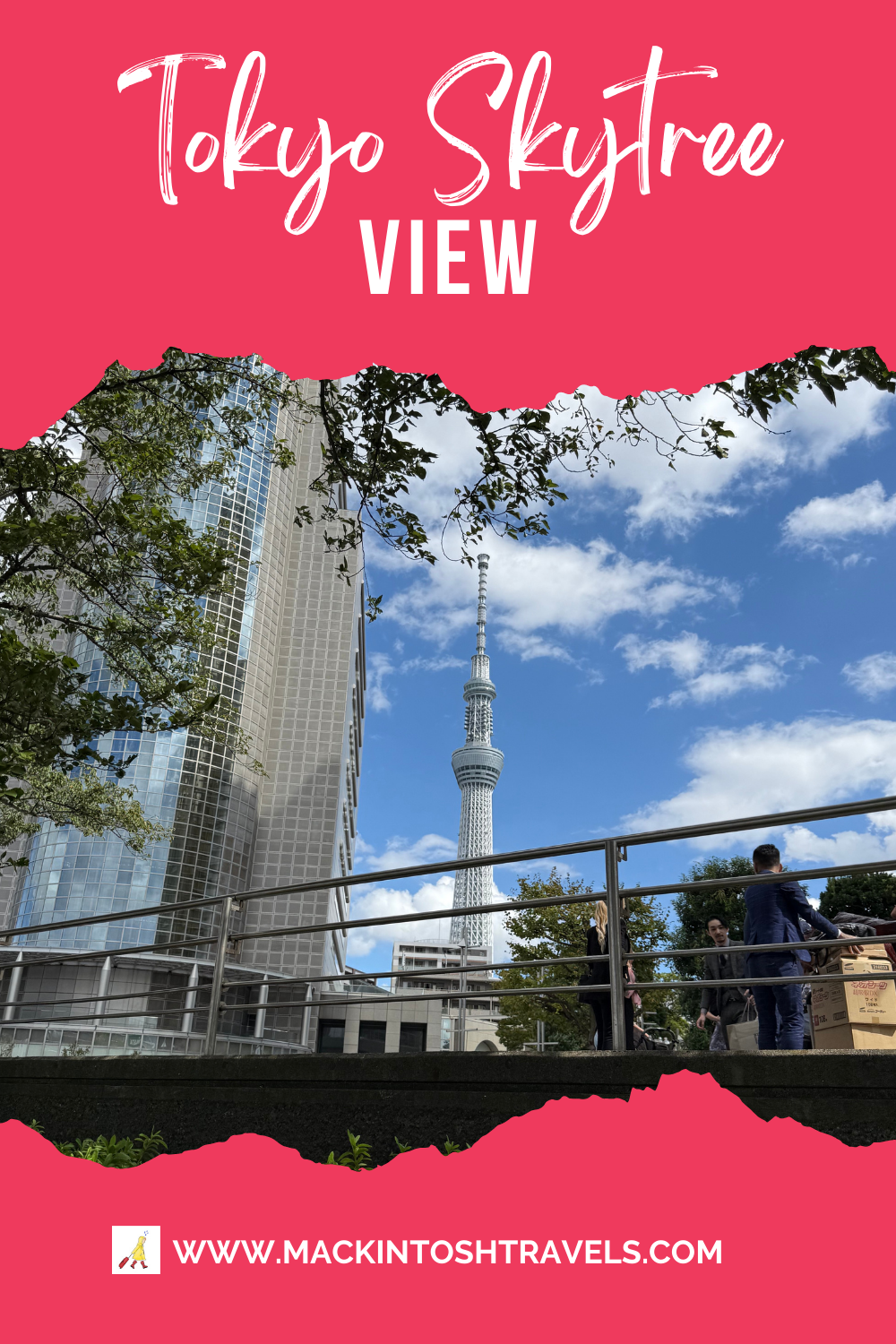
Tokyo is a city that knows how to blend tradition and modernism so seamlessly that sometimes you don’t even notice the shift until you step back and take it in. One moment you’re strolling through the quiet grounds of an ancient shrine with wooden lanterns glowing softly in the dusk, and the next, a futuristic skyline flashes neon against the night. Nowhere is this contrast more striking than when you see Tokyo Skytree soaring above the cityscape. It isn’t just a broadcasting tower. It’s an emblem of modern Japan, a marvel of engineering, a playground of entertainment, and for travelers our family, a place where you can feel the immensity of Tokyo all at once.
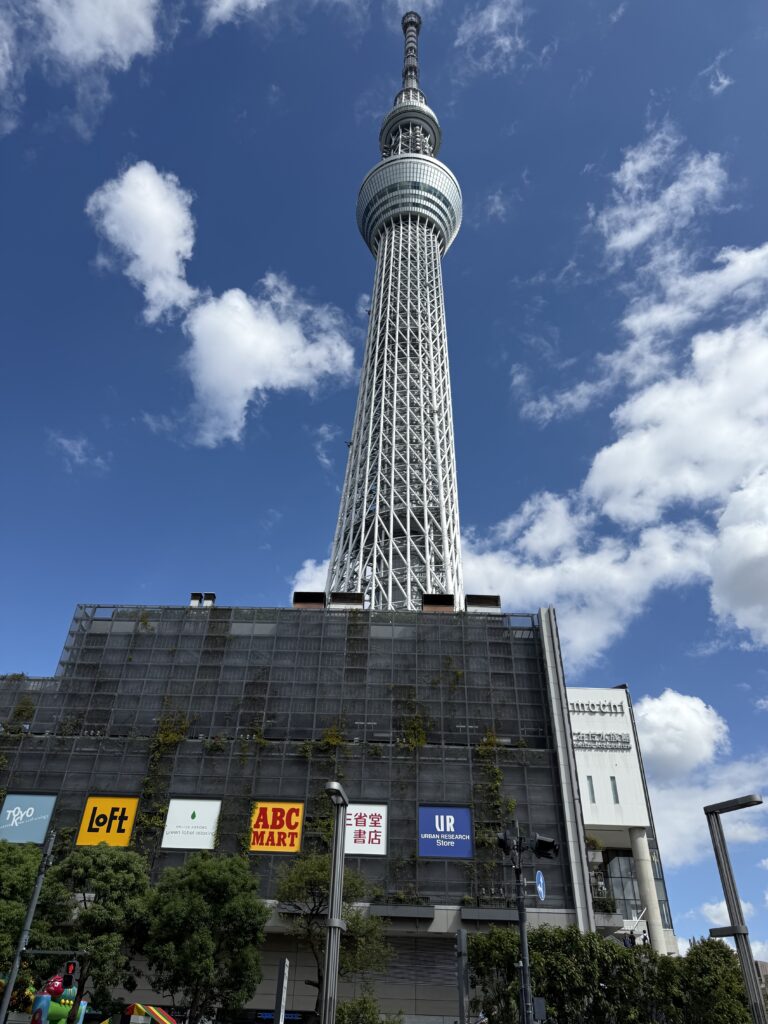
I still remember the first time I spotted it. We were walking in the quaint city when around the corner of my eyes I saw it! How can you miss it? It’s so tall! And yet, as my eyes adjusted, it felt like it was exactly where it was meant to be—a north star in Tokyo’s endless sprawl. Later that day, standing at its base, I felt both small and in awe. This isn’t just another sightseeing stop; this is a city experience in itself. This is one of the stops that the Eki stamp book can be stamped at!
The Height That Speaks History
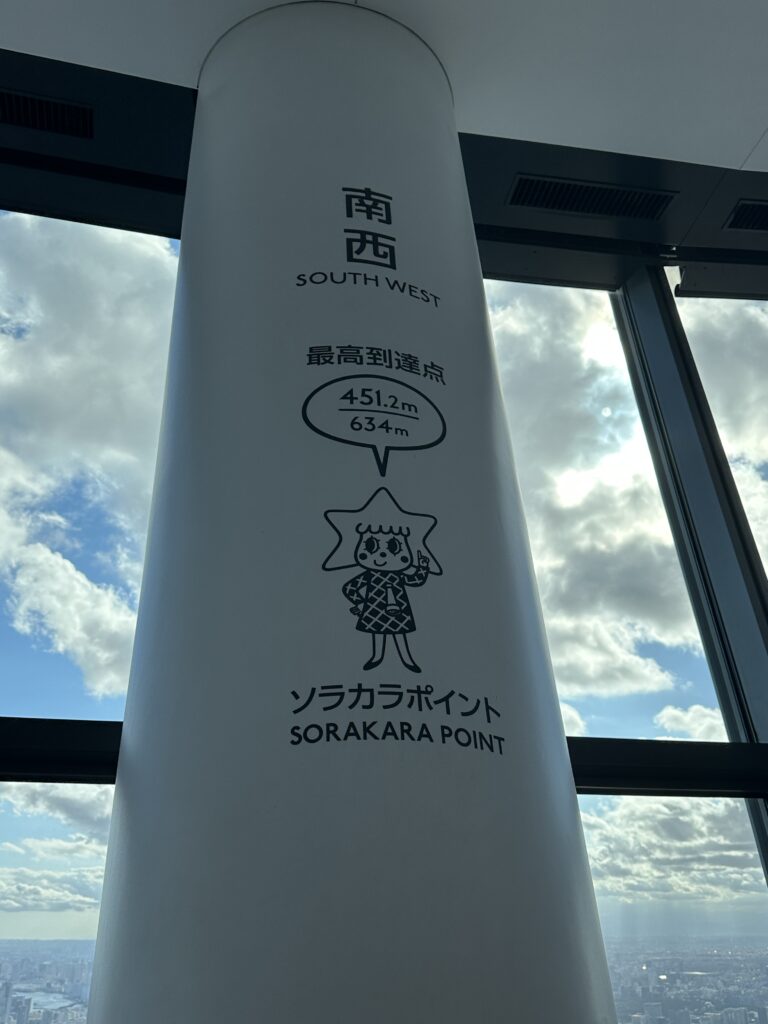
Tokyo Skytree measures an incredible 634 meters tall, making it the tallest structure or tallest tower in Japan and the second tallest in the world after Dubai’s Burj Khalifa. Numbers aren’t usually what stick with me when I travel, but this one does because of its cultural layer. You see, the number 634 isn’t random. In Japanese number wordplay called goroawase, 6 (mu), 3 (sa), and 4 (shi) combine to form Musashi. That’s the old name for the region that includes Tokyo and its surrounding prefectures. So even though the tower is a gleaming piece of futuristic design, its very height nods to the deep roots of the land it rises from. Interesting, right?
That’s what I love about Japan—you’ll find this subtle weaving of history into even the most modern of structures. It’s as if the past is always present, hidden in plain sight, waiting for you to learn its language.
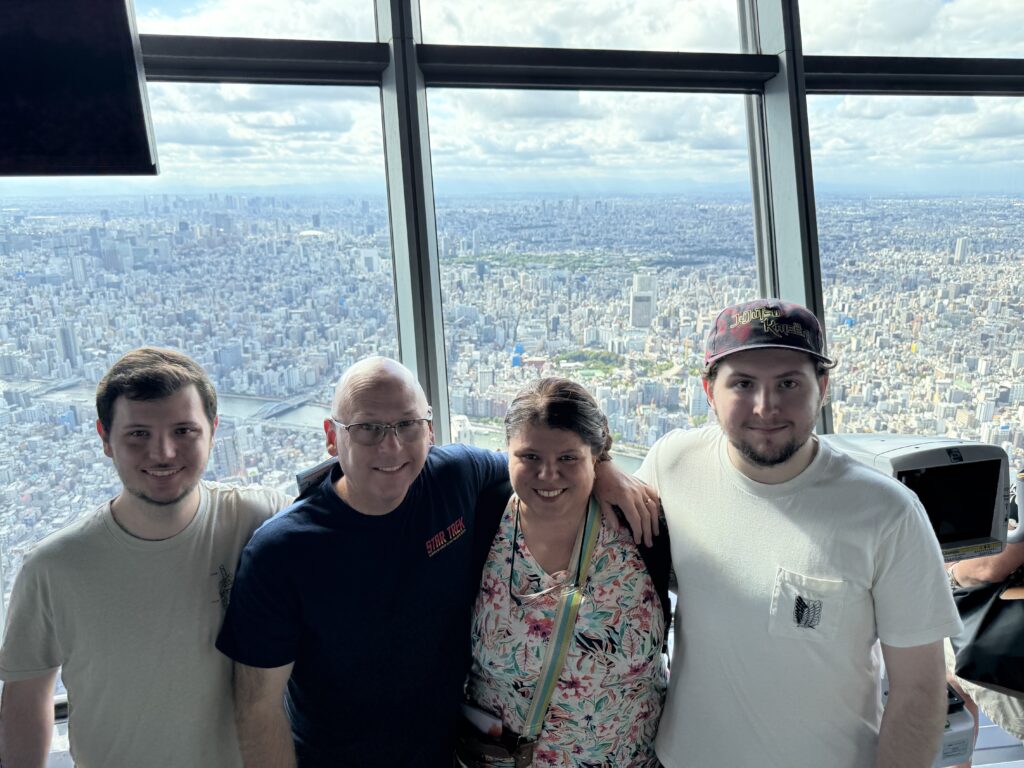
Us going into the elevator at Tokyo Skytree on the way up.In the elevator going up.
Earthquake-Proof Elegance
Japan is no stranger to earthquakes, so whenever something this massive is built, the first question is: how does it stay safe? The secret lies in centuries of wisdom. The architects of Tokyo Skytree studied ancient pagodas—the wooden temple towers that have survived countless earthquakes—and used those principles for the design. At the core of Tokyo Skytree is a central column, almost like a flexible spine, that helps absorb seismic energy. The outer structure is designed to move slightly with tremors, reducing damage.
Standing in the observation deck, with Tokyo stretching endlessly below, it’s hard not to think about how fragile things can feel. But knowing this blend of old architectural ideas and cutting-edge technology is protecting you gives a sense of calm. It’s like a metaphor for Japan itself: resilient, adaptive, yet always respectful of tradition.
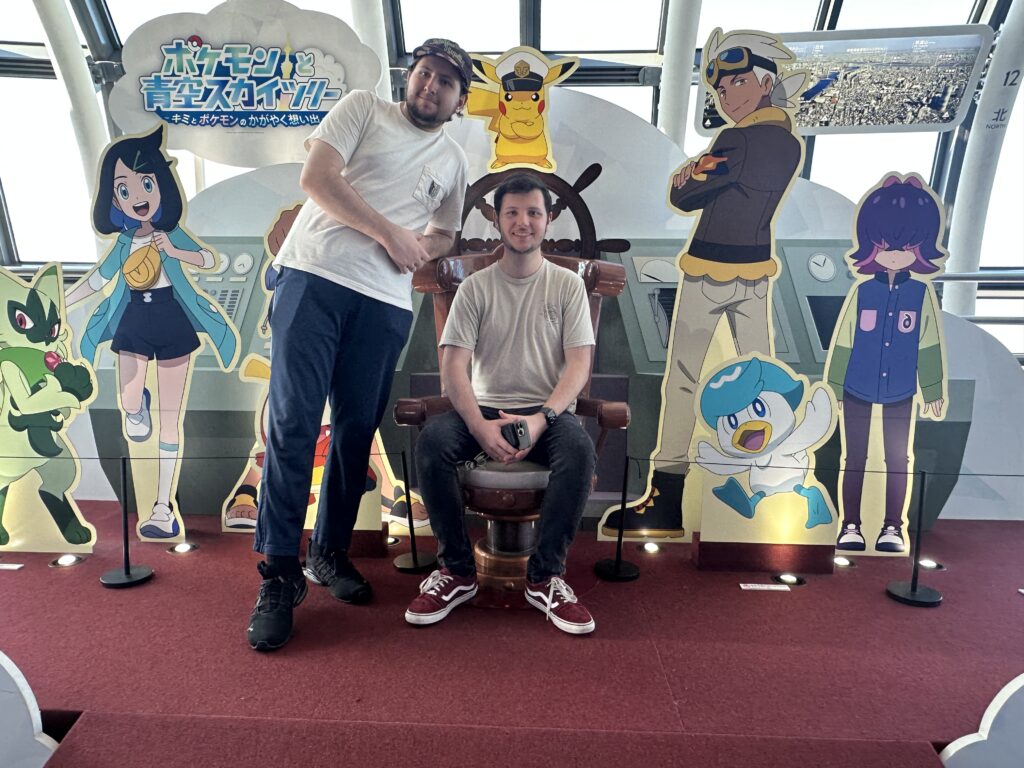
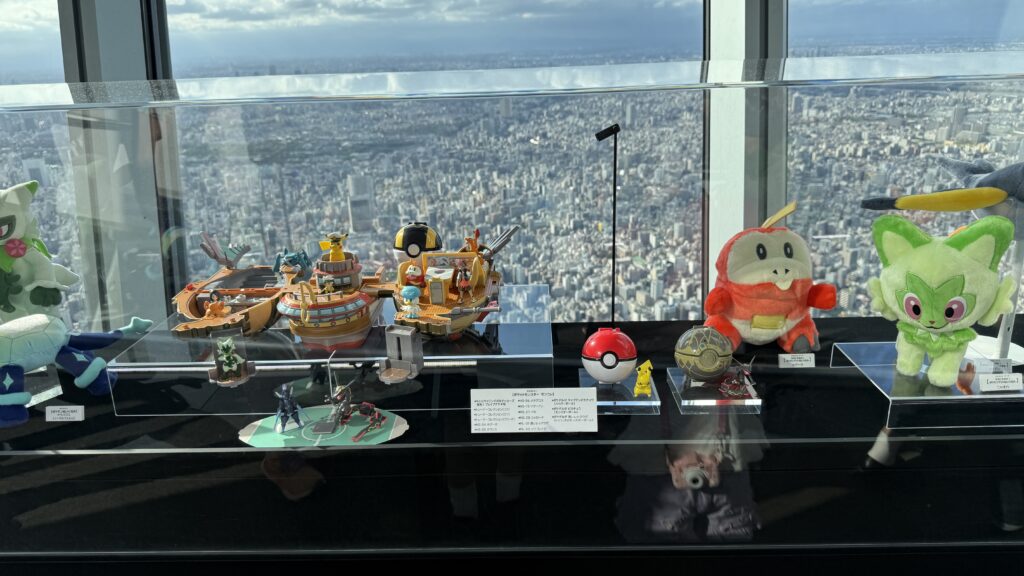
At this deck there were also some fun photo opportunities with characters that bring Tokyo Skytree to life with the culture it entails.
The Views That Go On Forever
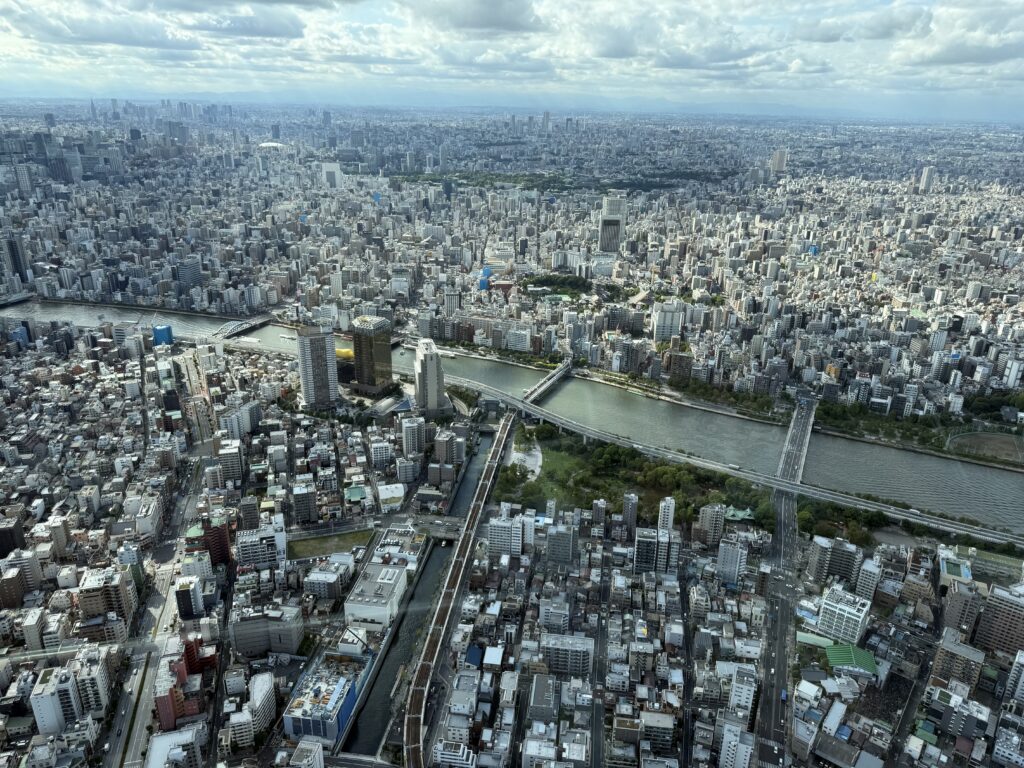
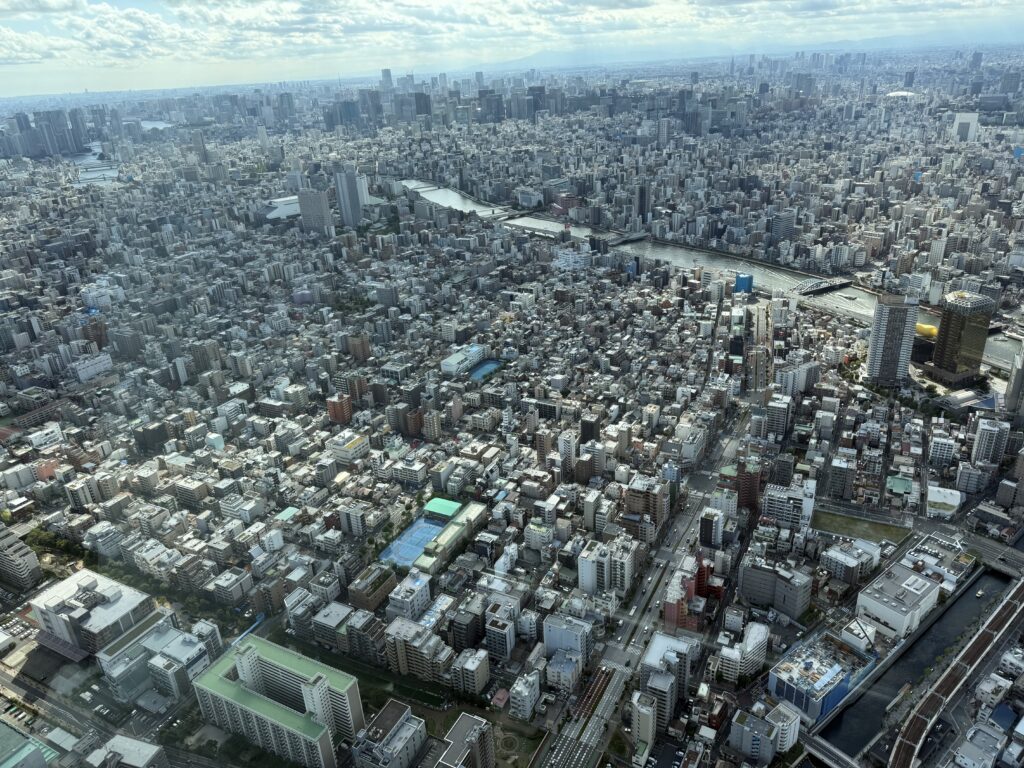
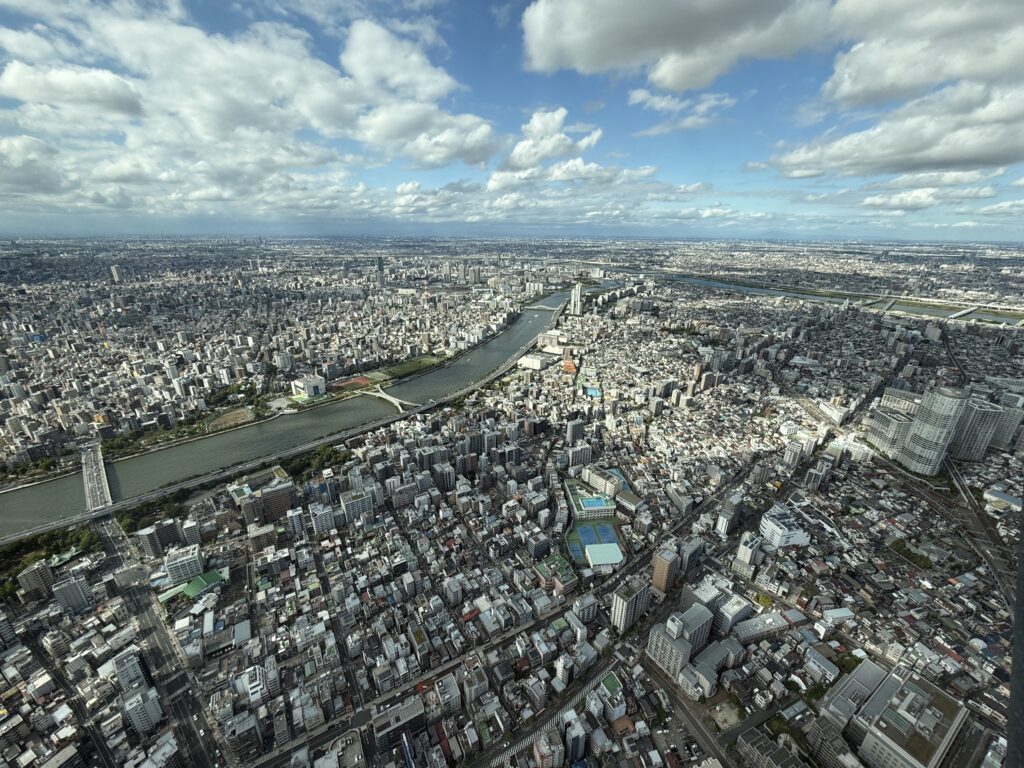
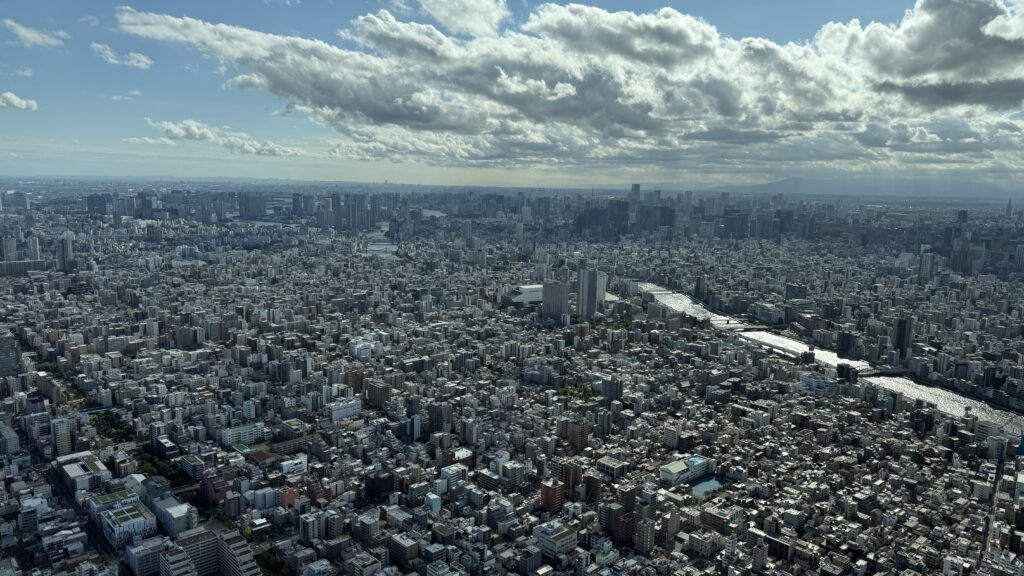
The highlight for most visitors is, of course, the views. There are two main observation decks, and they each offer a different experience. It offers panoramic views over Tokyo.
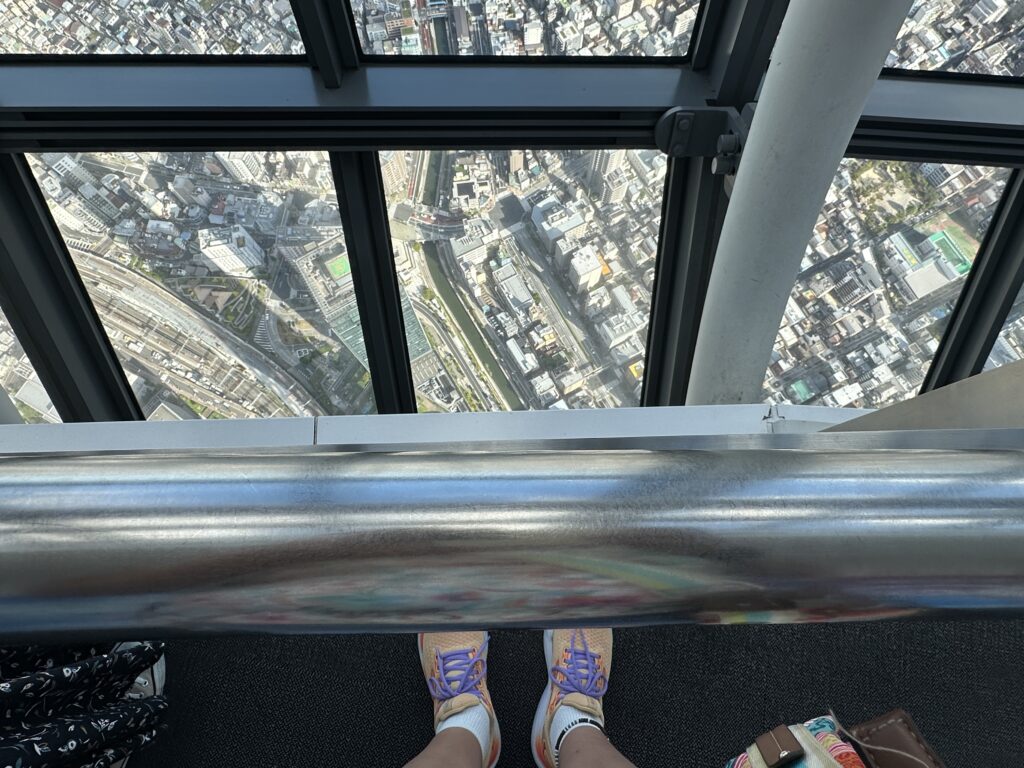
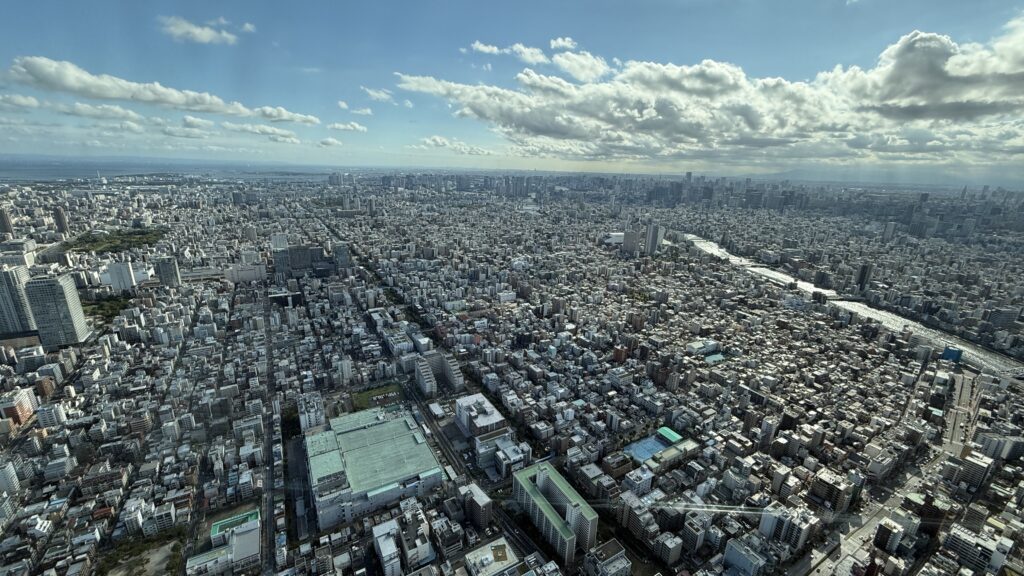
The first, the Tembo Deck at 350 meters, already feels like you’re looking out from the heavens. Through the floor-to-ceiling glass panels, Tokyo stretches in every direction, an endless sea of rooftops, highways, and green pockets of parks and temples. On clear days, you can observe Mount Fuji, but we were not fortunate to see it.
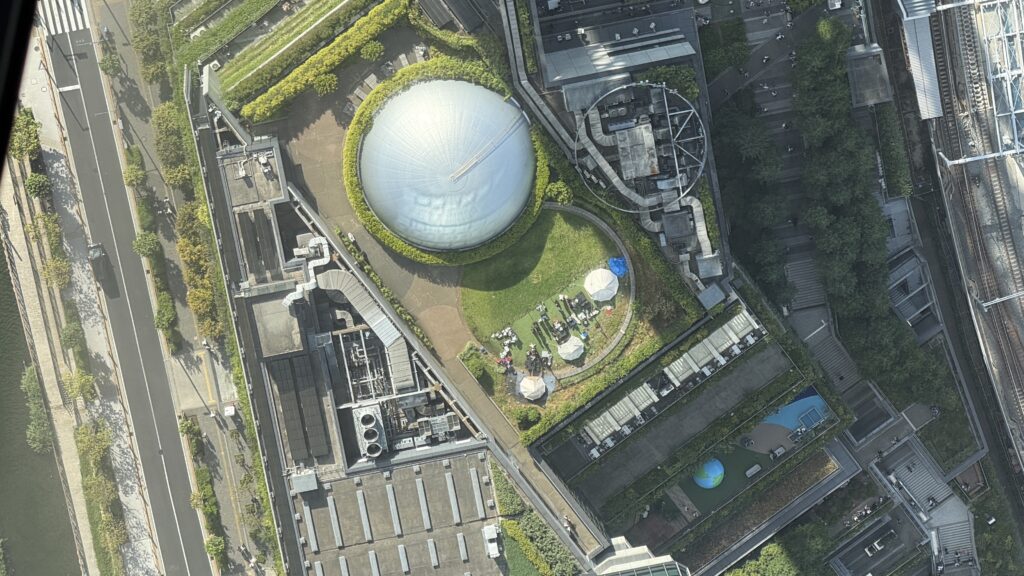
Then there’s the Tembo Galleria at 450 meters, often called the “world’s highest skywalk.” This is more than just an observation area—it’s an experience. The glass ramp spirals upward, giving you the sensation of floating as the city falls further and further below you. Even those who aren’t afraid of heights find themselves realizing how high up they are. It’s not scary, though—it’s exhilarating. A humbling reminder of how vast the city is, and how small we are in it.
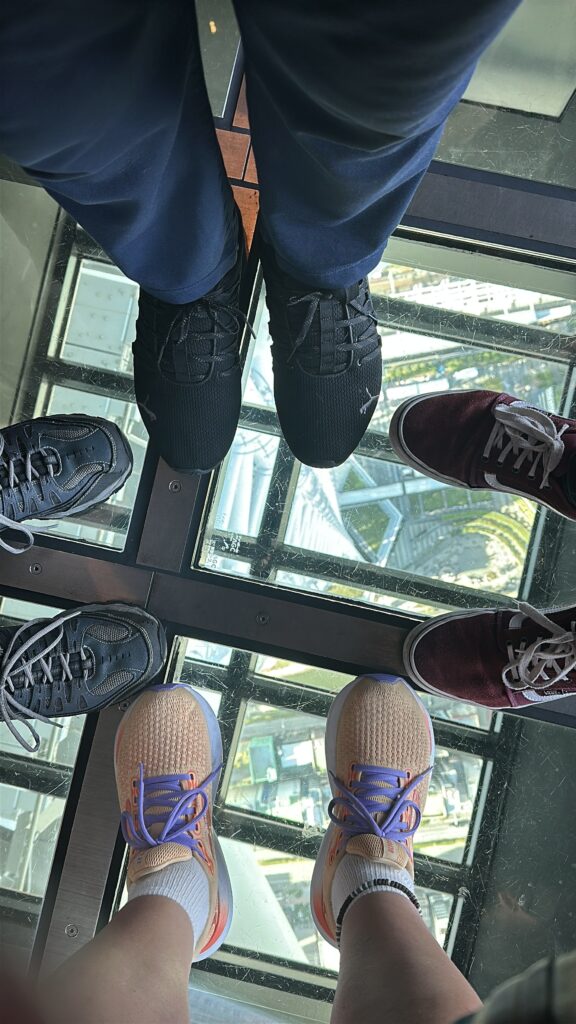
What’s fun is that you can also test your courage on the glass floor sections. Standing on transparent panels with only the city beneath your feet is both thrilling and nerve-wracking. I watched children hop on and off it without a care, while adults edged slowly, half-laughing and half-panicking (that was me somewhat). It’s those small moments that make the visit personal—you’re not just looking at Tokyo, you’re engaging with it in a whole new way.
A City Within a Tower
Tokyo Skytree isn’t just the tower itself. At its base is Tokyo Solamachi, a sprawling complex that could keep you busy for hours. This shopping and entertainment area has over 300 shops and restaurants, so even if you never go up the tower, there’s plenty to see and do.
Foodies, like me, will love it here. There are casual food courts, elegant restaurants, and snack stands offering quirky Skytree-themed treats, although we didn’t have any here.
Beyond food, Solamachi has a range of attractions. There’s an aquarium, Sumida Aquarium, which highlights Tokyo’s connection to the ocean, and a planetarium that offers a peaceful escape from the buzz of the city. Families especially love this part of the Skytree experience, but honestly, I think anyone can enjoy the variety. It’s part of what makes the Skytree feel like more than just a landmark—it’s a full day’s destination.
The Tower That Dresses for the Night
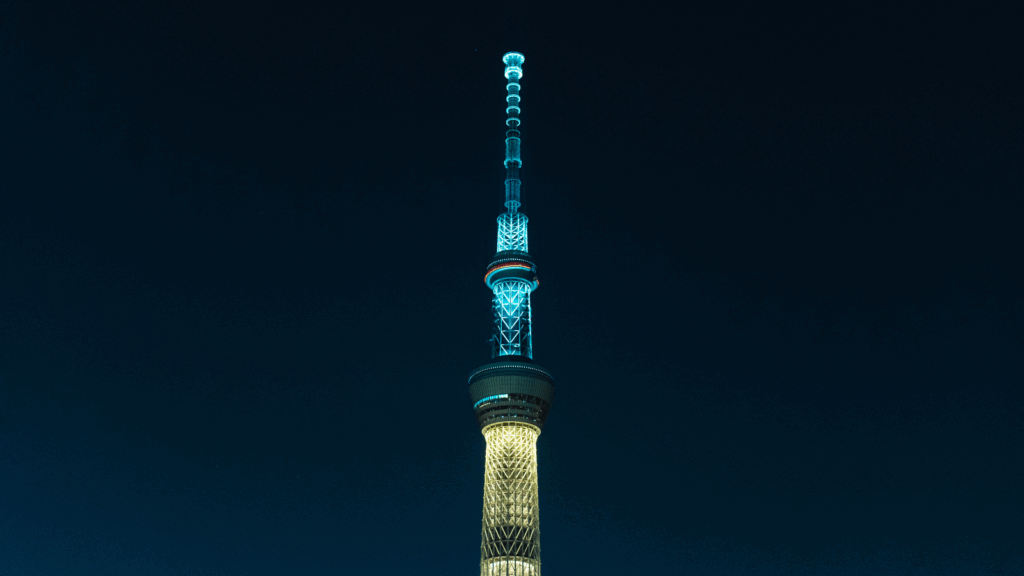
If daytime Skytree is all about the views, nighttime Skytree is about the dazzle. As the sun dips below the horizon, the tower transforms into a glowing piece of art. The lights change color depending on the season or occasion. The two main patterns are Iki, a pale blue inspired by the rivers of Edo (old Tokyo), and Miyabi, an elegant purple that reflects refinement and tradition. Sometimes the colors shift to pink for cherry blossom season. We didn’t visit during cherry blossom season, but that would have been gorgeous! We went in early October.
If you’re visiting Tokyo, I recommend taking a night stroll along the river just to catch this view. It’s one of those things that I wish we would have done.
(Photo by Canva)
Little-Known Secrets
Here’s something many visitors don’t realize: on crystal-clear days, you can see Tokyo Skytree from as far away as Nikko, nearly 100 kilometers from Tokyo. And from the tower itself, the view stretches even farther than most people expect. You can see the Pacific Ocean glittering in the distance, and in winter, the mountains etched sharply against the sky.
Another fun fact? When it opened in 2012, tickets were so in demand that people queued for hours. Now it’s easier to visit, though weekends and holidays can still mean long lines. Pro tip: book your tickets online ahead of time to skip some of the wait and save money (we paid about $20 per person for the combo deck tour), or visit early in the morning for a calmer experience. This is exactly what we did and it worked out perfectly! And, don’t get Tokyo Skytree confused with Tokyo Tower which is near Shibuya. They are both within a 30 minute transportation distance.
Experiencing Skytree as a Traveler
For me, the magic of visiting Tokyo Skytree wasn’t just about the view—it was about perspective. Seeing Tokyo from the ground can feel overwhelming. The city is so vast, so alive, and so layered that it’s easy to get lost in its neighborhoods and forget the bigger picture. But from the top of Tokyo Skytree, you see it all at once—the density, the order, and the beauty. You realize how much Tokyo is both a city of the present and a story still being written.
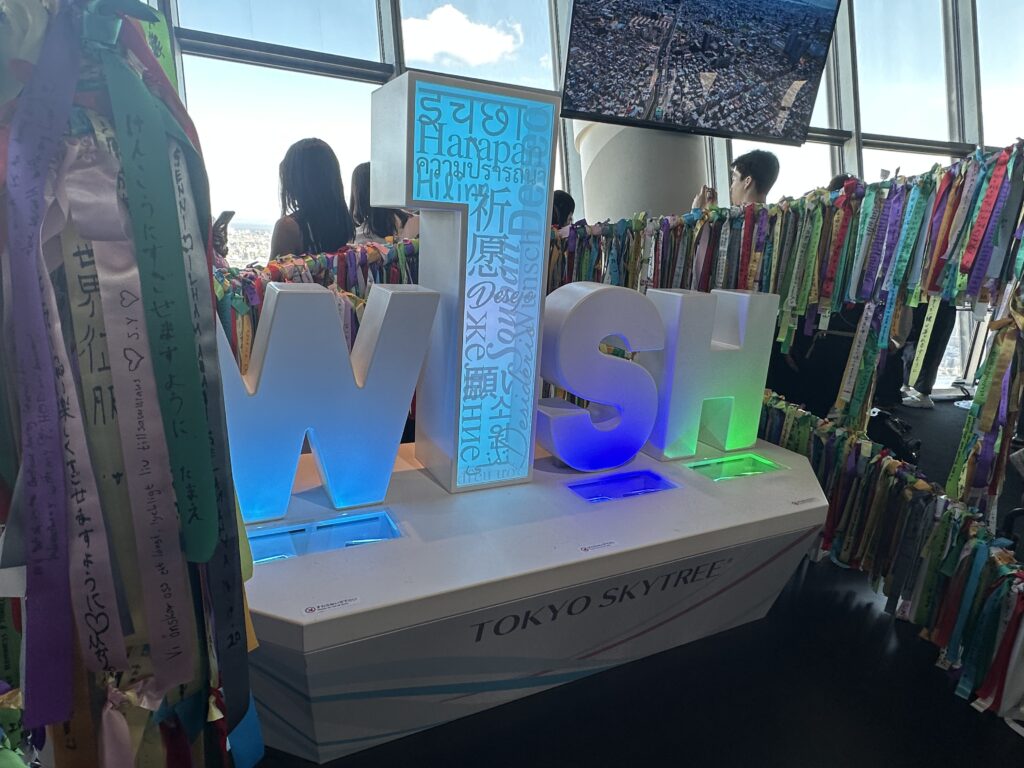
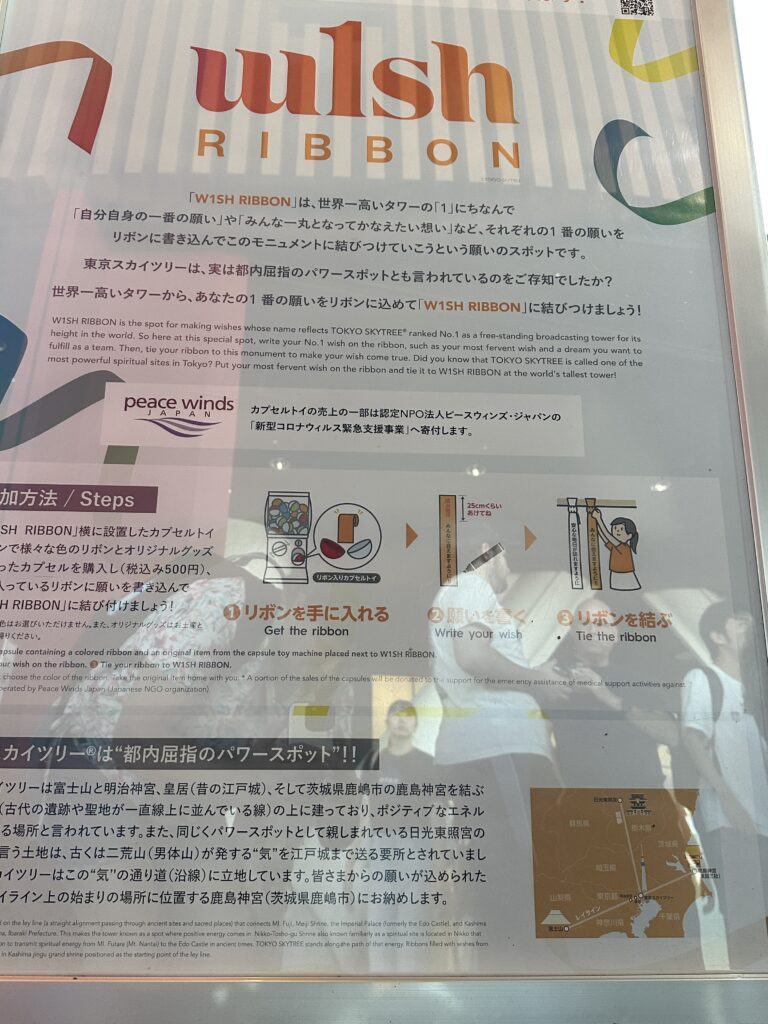
When we visited they had a WISH ribbon activity in which you can write down your wish and tie it with a ribbon. They say that Tokyo Skytree is considered one of the most powerful spiritual sites in Tokyo. This is part of their culture. We did not partake, but it was interesting to see others do it.
Final Thoughts
Tokyo Skytree is more than a sightseeing checklist item—it’s a lens into the character of Tokyo itself. It blends the future and the past, function and fun, scale and intimacy. It’s a place where you can feel both the enormity of a city and the smallness of yourself, and yet somehow walk away feeling uplifted.
Whether you go for the views, the food, the shopping, or simply to stand in awe at its base, the Skytree delivers an experience that reflects Tokyo’s very spirit: modern yet rooted, playful yet practical, overwhelming yet inviting.
From a cost savings perspective, Japan doesn’t have to be an expensive vacation. In fact, there are three things that made up the bulk of our budget of a family of four. Those three things were: flights (coming from Florida), hotels (we stayed in two different cities: Tokyo & Osaka), and Shinkansen transportation (that’s transportation from one city to another). Everything else we found to be cheaper than home. For instance, the food, souvenirs and subway transportation within Tokyo were relatively inexpensive.
And the best part? Tokyo Skytree doesn’t just tower over the city. It becomes part of your Tokyo story. It’s a must visit if you’re a first timer in Tokyo!
If you have a specific question about this post, please email me.
Have you ever walked into a business and your mouth just dropped? High-tech businesses with great concepts is the future and this innovative robot cafe is just that! DAWN Avatar Robot Cafe in Tokyo, Japan employs disabled people to be the faces behind the robots. …
A Tokyo Imperial Palace visit is like someone just threw me from the modern Nijubashimae Station into the Edo period. You can also arrive at the Otemachi Station from the Tokyo Station connection to arrive at the Imperial Palace. The Tokyo Imperial Palace will leave you …
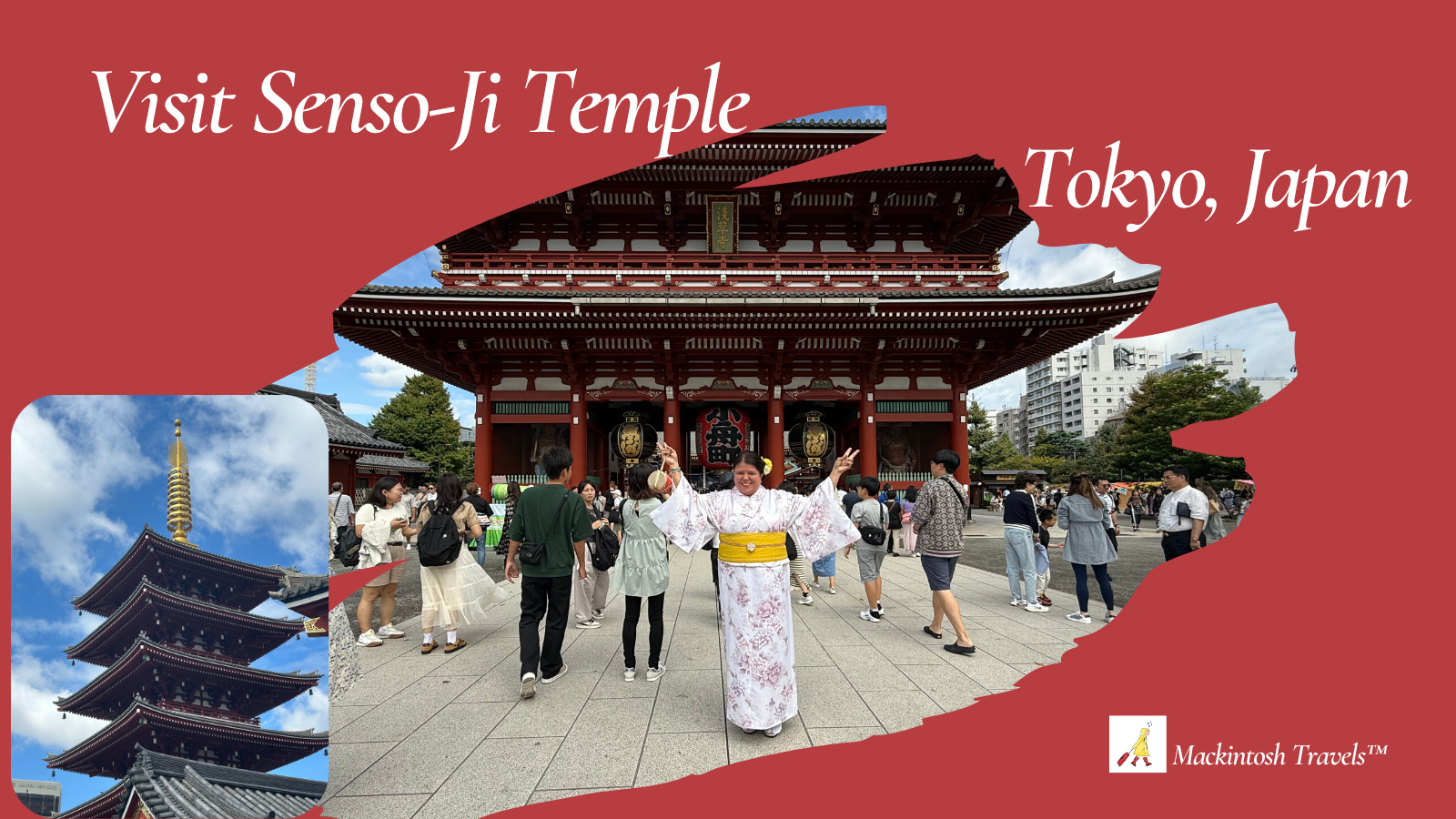
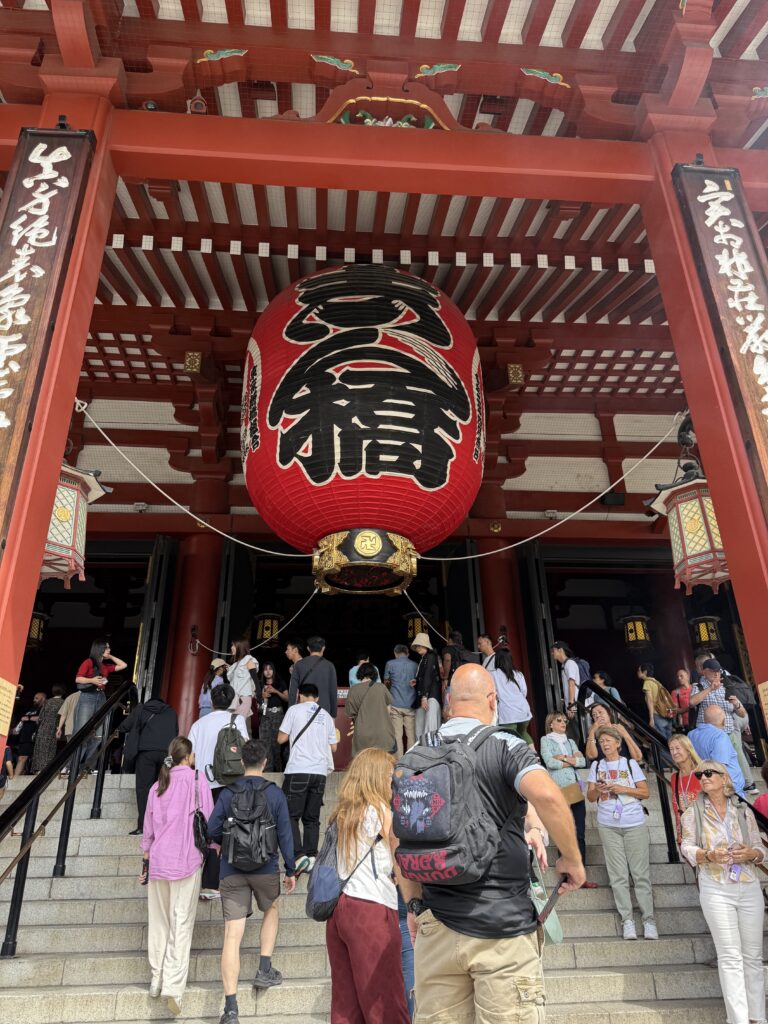
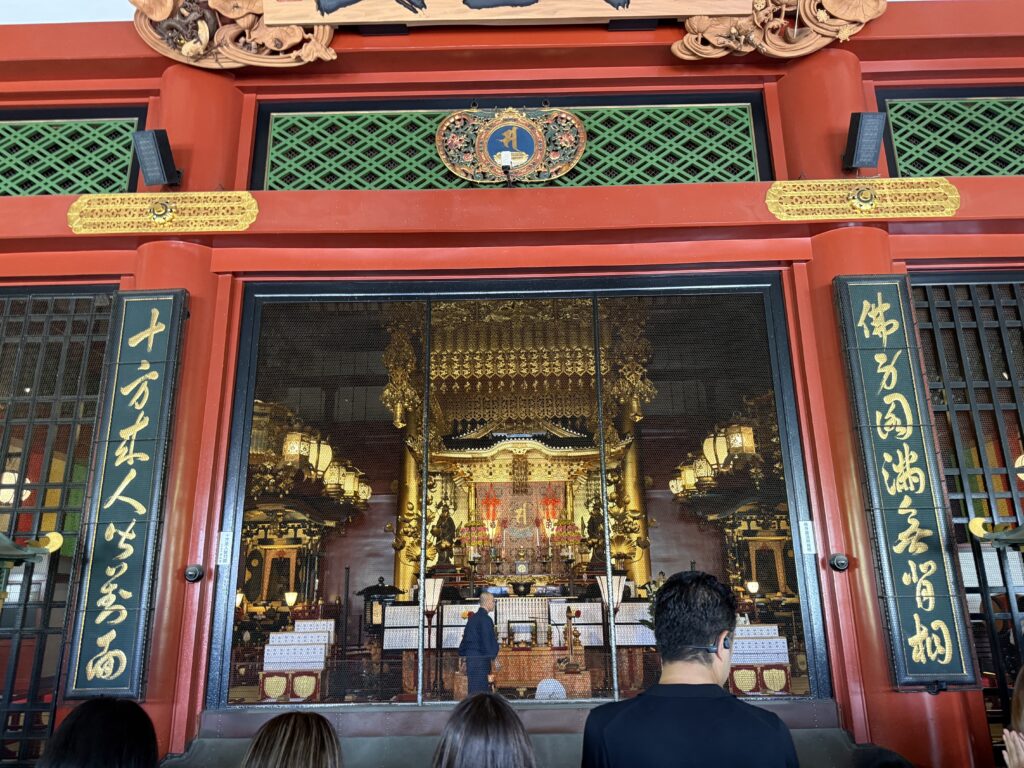
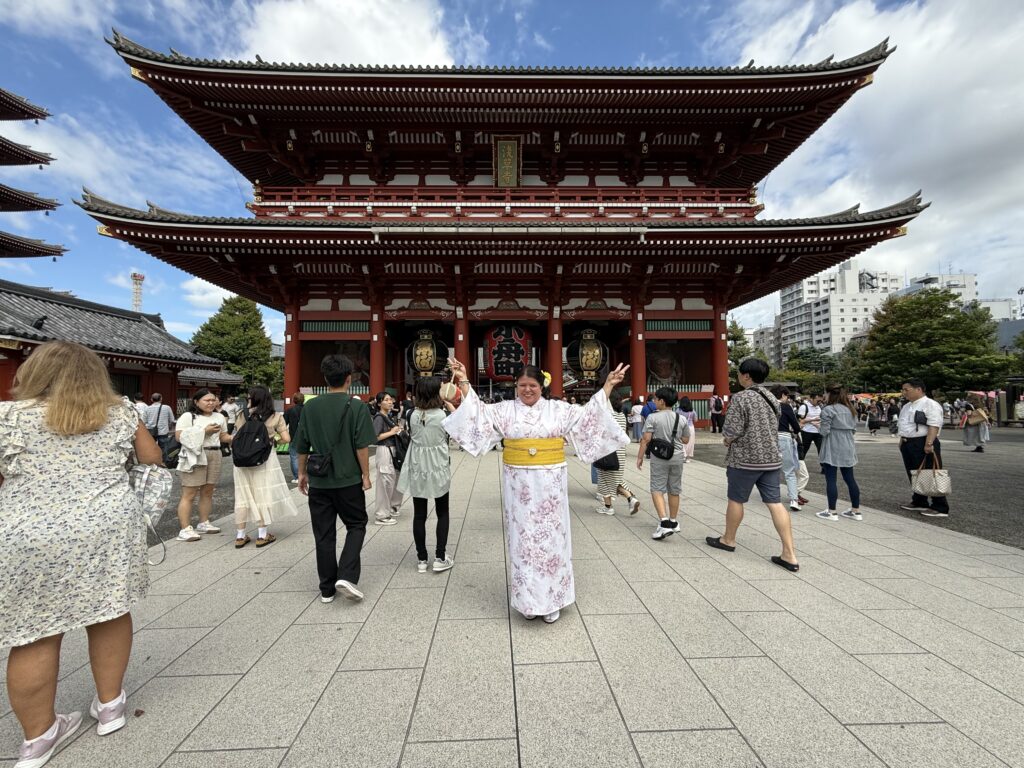
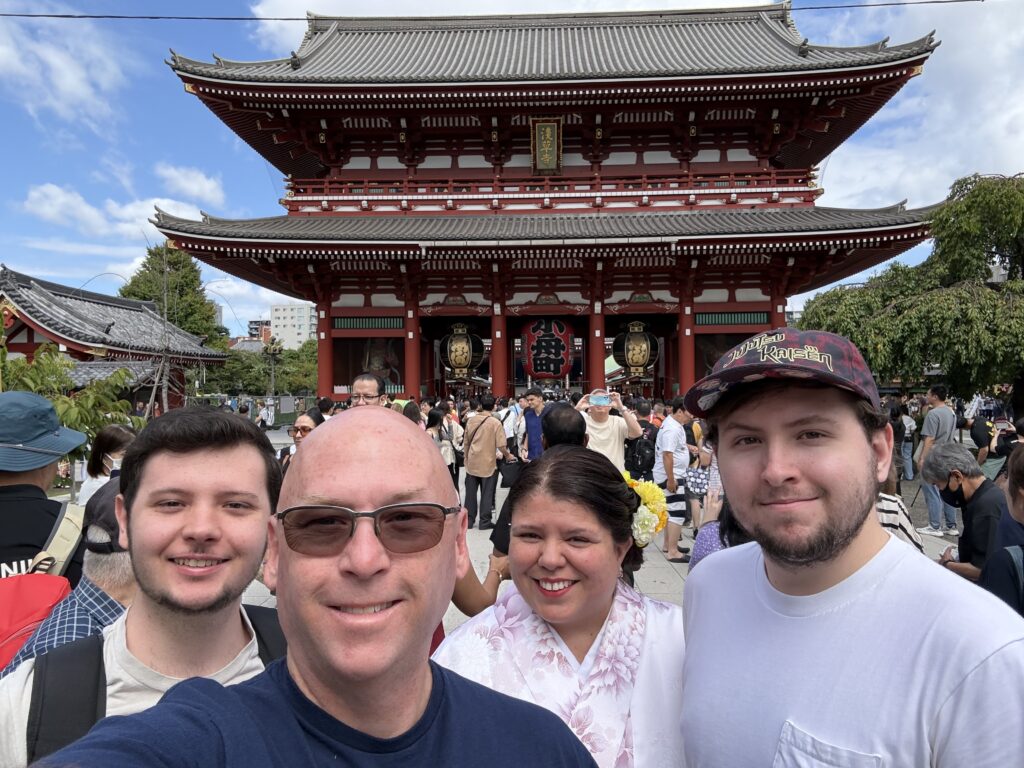
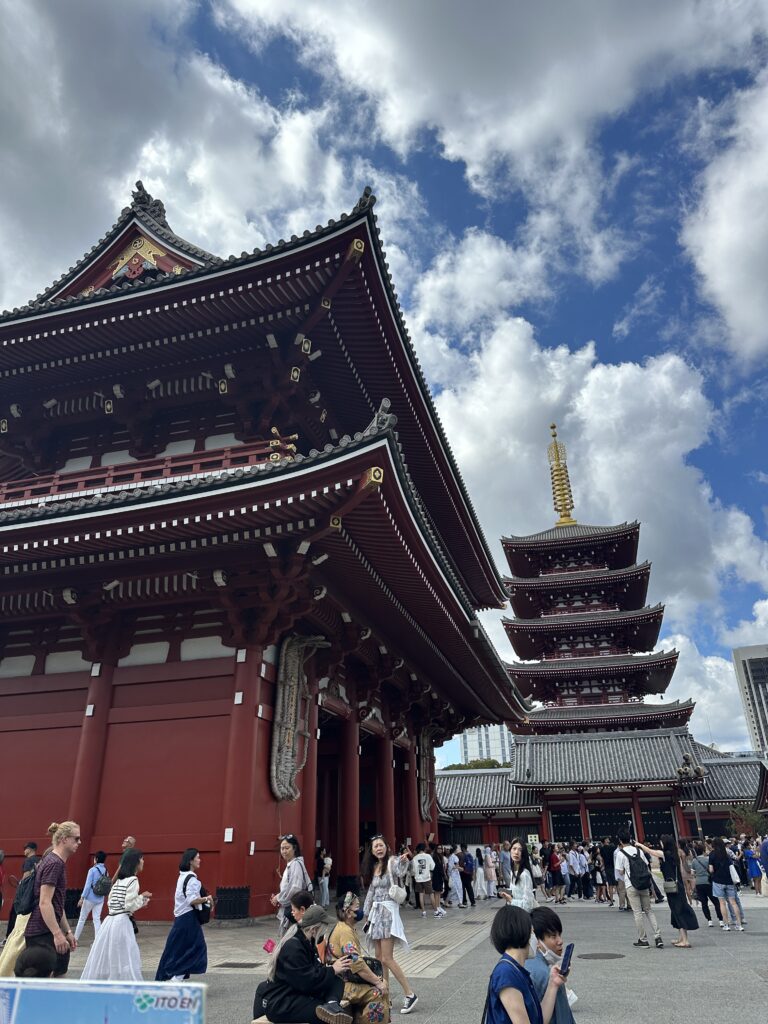
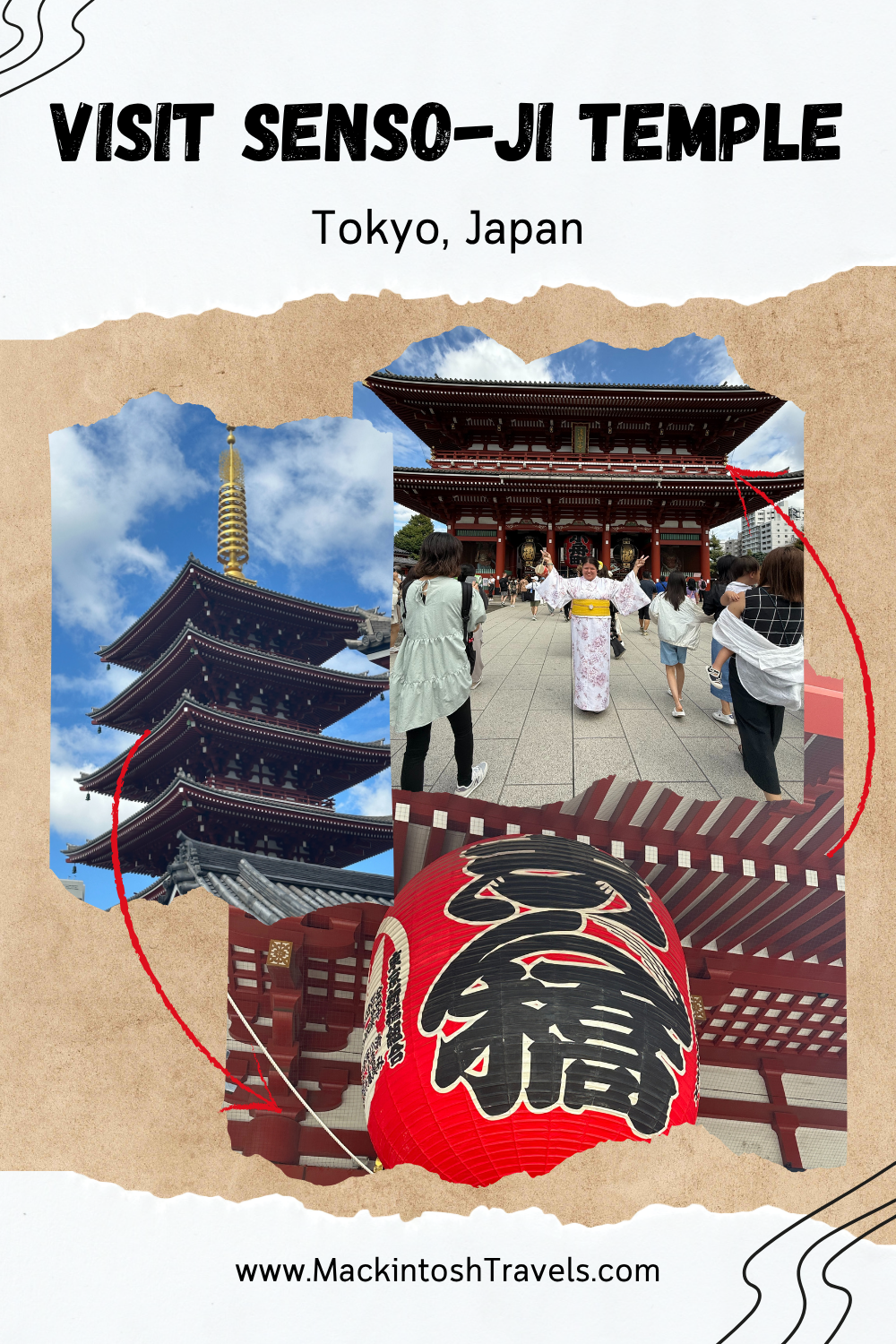
Senso-Ji Temple is Tokyo’s most famous and oldest temple that tourists visit. If this is your first time in Tokyo, I highly recommend a visit. In association with the 7th century, this period is known as the Edo period. You can hop off the Tokyo Asakusa Station and take a short walk to the Kaminarimon Gate (Thunder Gate). A giant red lantern hangs in the center of the main gate and is considered the main temple.
As we walked toward the temple, we noticed a map and realized this entire area is bigger than we thought. Yes, you will hear people talking, but the talking is at a minimum noise level. You will smell incense in the air. This place is a temple after all and people are worshipping.
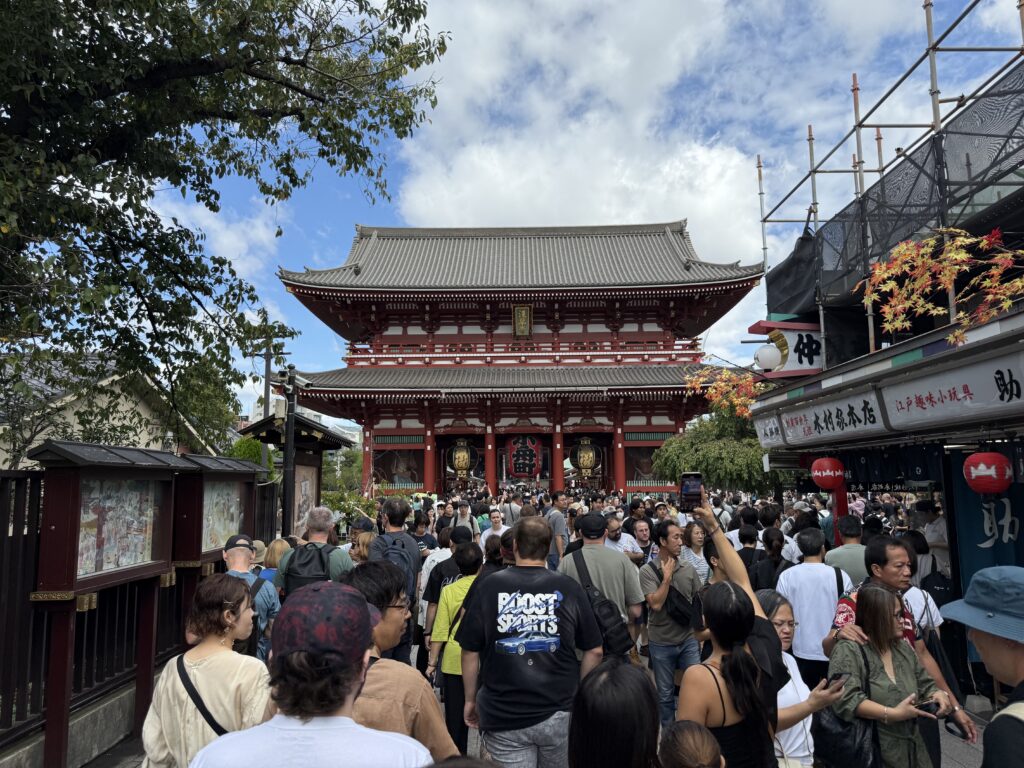
We arrived to Senso-Ji Temple around 9am Tokyo time and it was already busy here. It does get busier throughout the day, so I suggest getting here as early as you can. There is a shopping street and you can grab food here as well.
Here at the base of the temple people worship by clapping their hands and forming them in praying formation. It was come to my attention that people clap their hands to show respect and get the attention of the spirits to listen to their prayers.
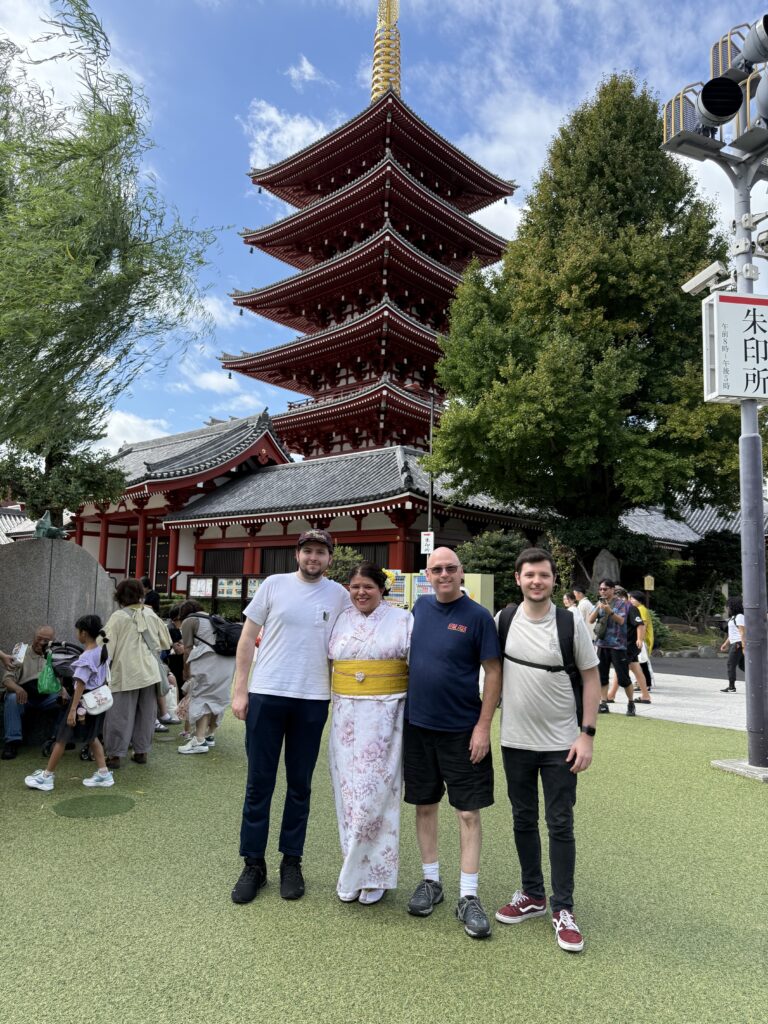
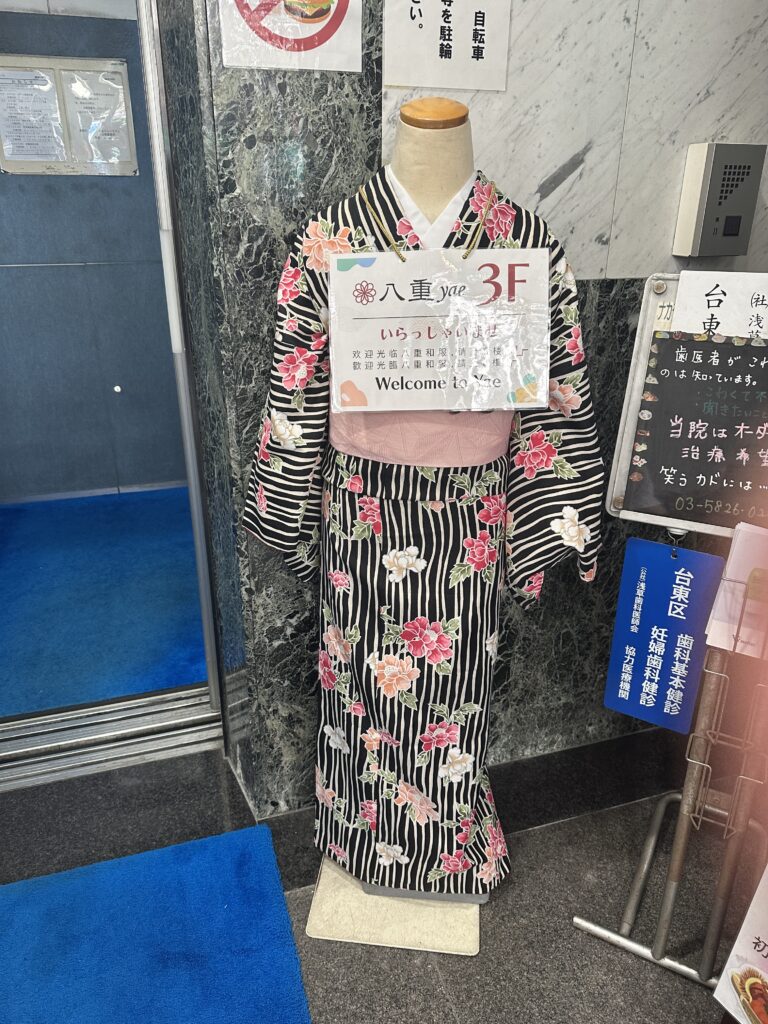
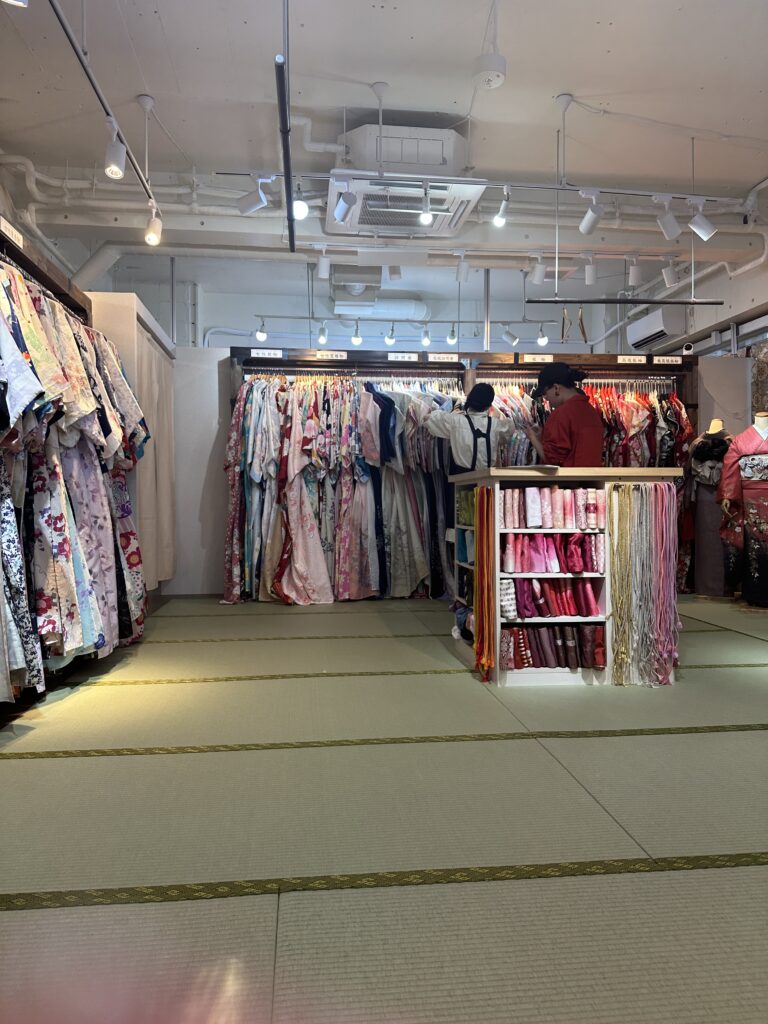
Just a short walk away from Senso-Ji Temple is a nearby Kimono rental storefront called Yae. It was about $50 for an all day kimono rental plus hairdo. These make great photos at the temple! Men outfits are also available.
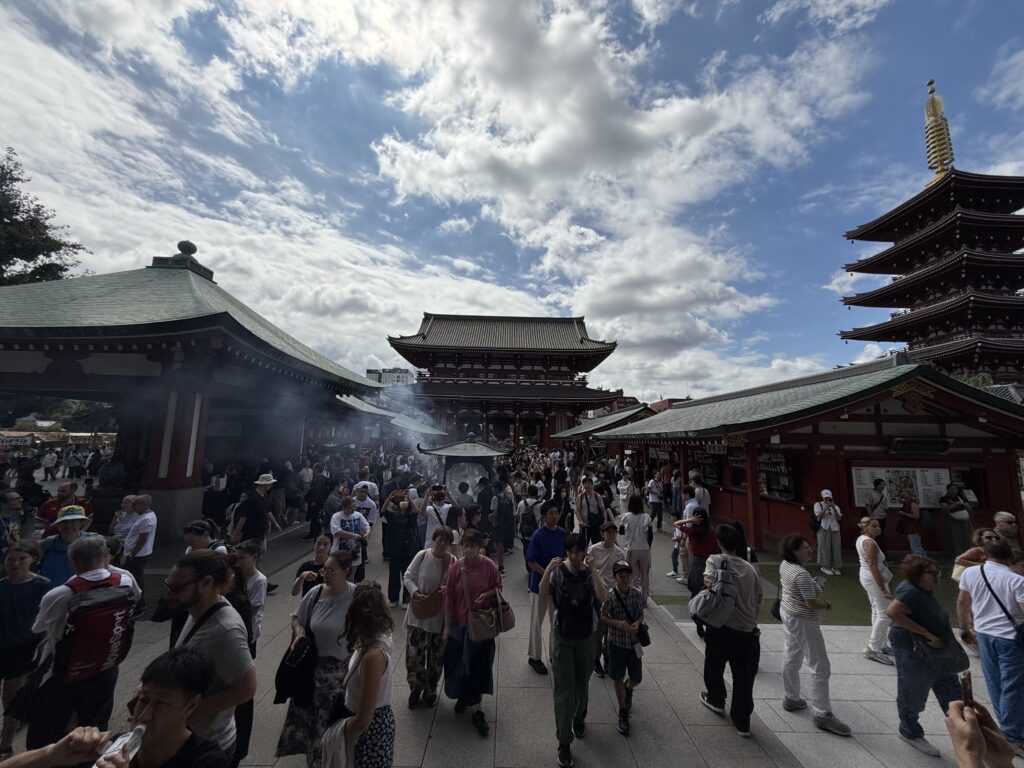
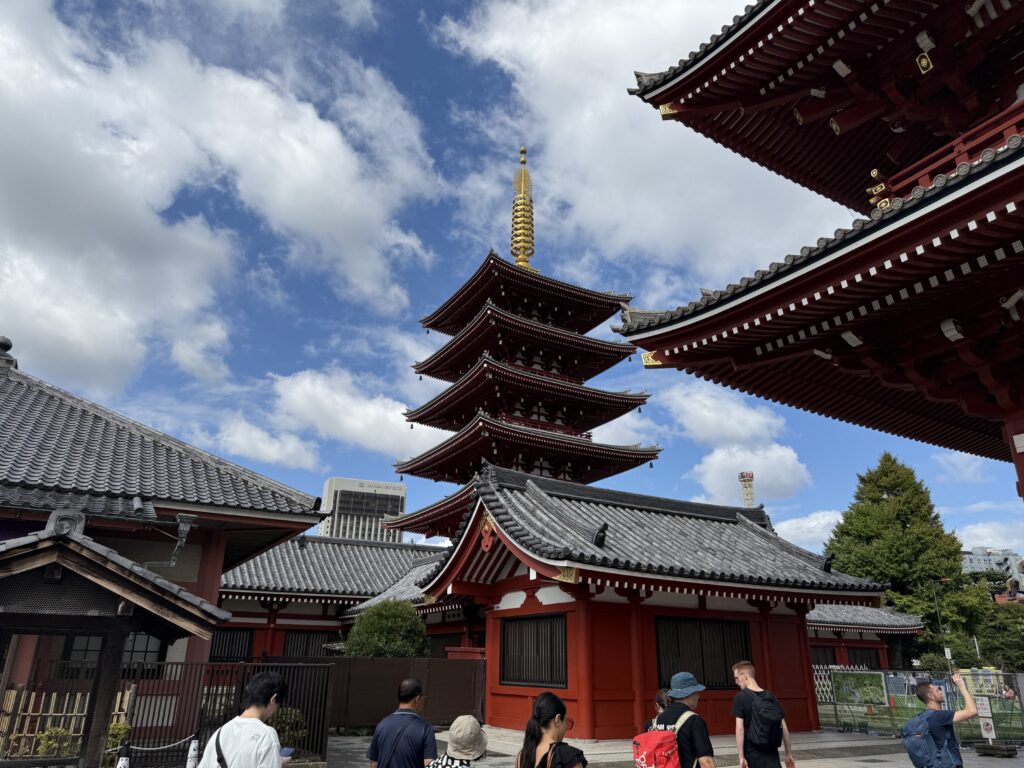
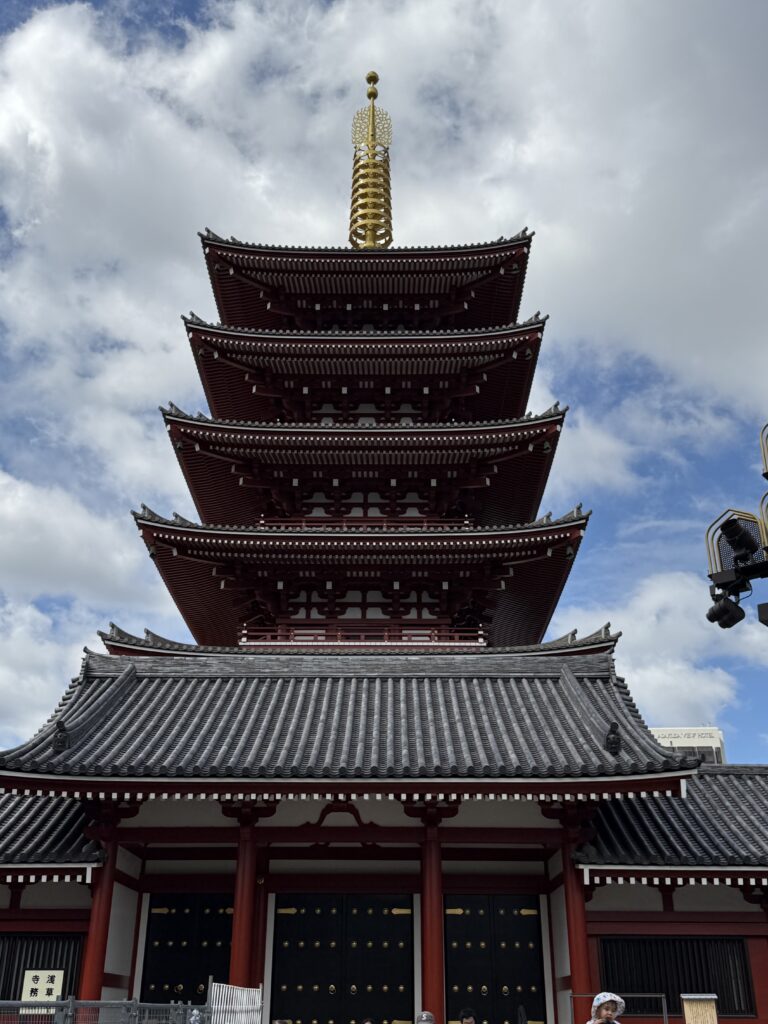
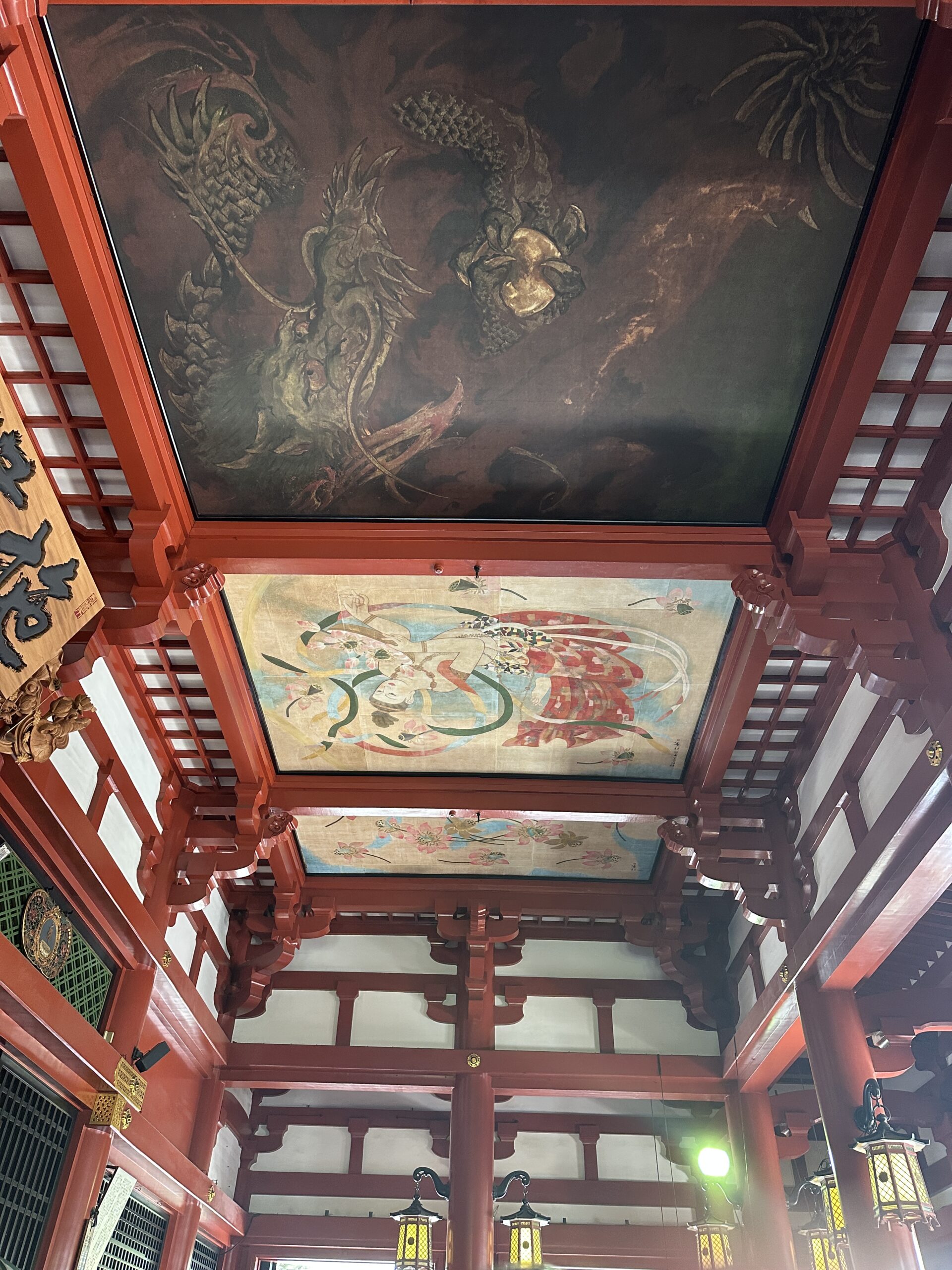
What I love most about Japanese temples is the architecture. I love the height of the layers and the peaks that flare up at the corners. The colors are bold and since red is my favorite color its no wonder I love these structures so much. I just think it looks stunning! This 5-story pagoda is one of Tokyo’s tallest.
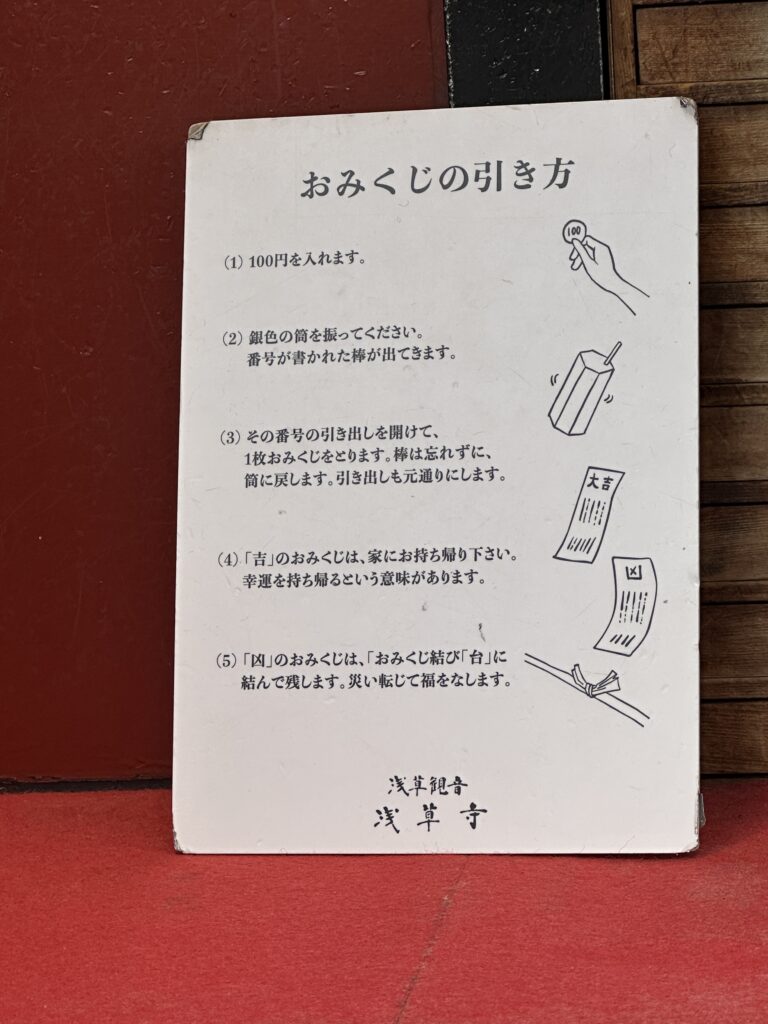
For a small fee, you can receive a paper fortune called omikuji through a box. If you receive a bad fortune, you can tie it to a designated area and leave it behind. This symbolizes that you’ve left the “bad” luck behind.
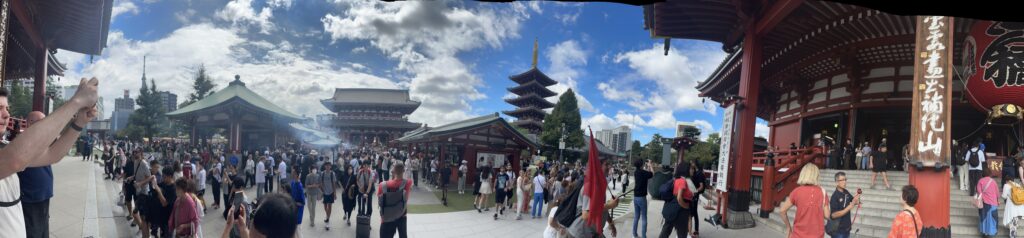
Panoramic view of Senso-Ji Temple grounds.
Ueno Park
With only a 7 minute walk away, you can visit Ueno Park. We didn’t walk too much around here, but it looks like a great place to visit especially during cherry blossom season. It is a large park that is famous for many museums: Tokyo National Museum, National Science Museum, National Museum for Western Art, Tokyo Metropolitan Art Museum and also is home to Ueno Zoo.
If you’re especially visiting Tokyo for the first time, make sure you don’t miss visiting Senso-Ji Temple. You will never forget your experience at Tokyo’s most famous and oldest temple.
If you have a specific question about this post, please email me.
A visit to Tokyo Tower is a must if you’re visiting Tokyo for the first time. It resembles the Eiffel Tower in which you can visit the observation decks. However, Tokyo Tower is the tallest tower in the world making it a popular tourist spot! …
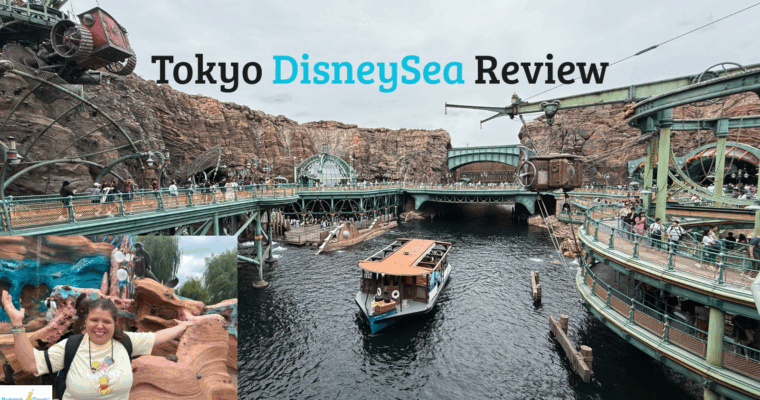
If you’re a Disney fan and contemplating whether to visit Tokyo DisneySea because you think it’s similar to Tokyo Disneyland or any other Disney park you’ve been to, you’re wrong. Tokyo DisneySea is like no other theme park I’ve ever been to. That’s saying a …
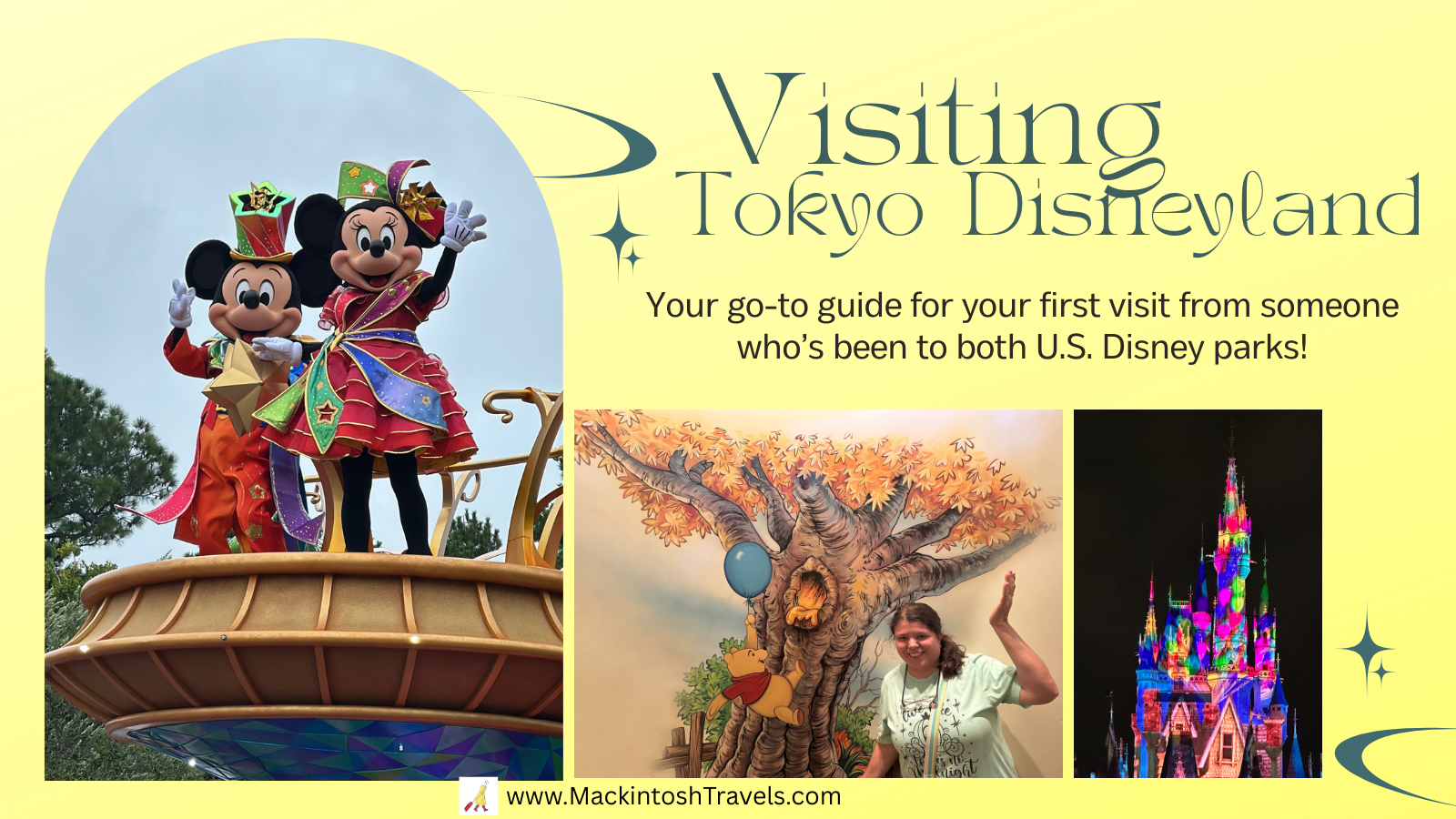
If you’re planning on visiting Tokyo Disneyland I am so excited for you because you’re in for a HUGE treat! I have been to Disneyland in California, Walt Disney World in Orlando (where we go the most often) and Tokyo Disneyland. I have to say that Tokyo Disneyland is an amazing and unique park in comparison to all the others. And, if you’re visiting Japan for the first time, make sure you don’t miss visiting Tokyo Disneyland because I was in Paris twice and I regret not visiting Disneyland in Paris. But, maybe we’ll go back one day.
Getting Tickets
Reserving your tickets is a straightforward process, but there are a few key details to keep in mind to ensure a smooth experience when visiting Tokyo Disneyland. Tickets can be purchased through the official Tokyo Disney Resort Online Reservations & Tickets website or via the Tokyo Disney Resort App. Also, make sure that you utilize the Tokyo Disney Resort app once you’re in the park to get all the latest wait times & ride reservations. It’s important to note that ticket booths at the park are currently closed, so online purchase is the primary method for securing your admission. Please check ahead as this may change at any time.
In case you encounter issues with international credit cards on the official site (and we have heard of this happening, but we didn’t have any problems here in the U.S.A.), third-party platforms like Klook are available as alternatives. These platforms provide QR codes that can be scanned into the Tokyo Disney Resort App, facilitating park entry.
Transportation To/From The Park
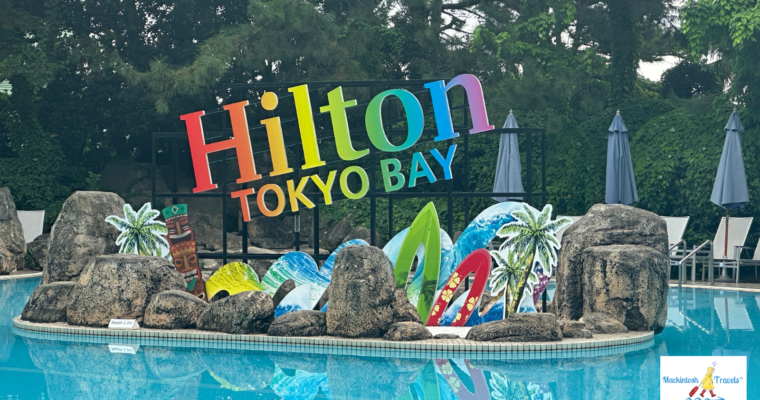
Transportation to and from the park is very easy because Tokyo has a wonderful subway system. However, if your hotel stay is anywhere near the Maihama or Bayside Station, you will be in the heart of the entire Disney atmosphere because you can literally walk to the entrance of Disneyland. Our hotel can be seen from Bayside Station. We stayed at the fabulous Hilton Tokyo Bay.
The monorail at these stations have large Mickey windows & Mickey grab handles if you’re standing making it a whimsical & fun start and end to your Disney day!
That’s our hotel!
The Line
Getting in line is easy, but be ready for VERY long lines. The lines do move quickly, which is the opposite of Tokyo DisneySea. However, people here are accustomed to sitting down and waiting on what they call Tatami mats. They bring their own. Tatami mats are just a clean way to sit on the floor using a floor covering. Many come in different styles & colors.
Parade
The afternoon parade is truly special! All the songs are in Japanese, but the magic still is still there so don’t let that fade your opinion to not watch. All of your favorite characters will make an appearance!
Dining/Food
Blue Bayou Restaurant, is a gorgeous restaurant overlooking the Pirates of the Caribbean. They serve delicious French and Creole-style dishes.
The castle is always the heart of every Disney park, right? It’s the central meeting place. It’s your home away from home. It is after all Cinderella’s living quarters. Every castle at each Magic Kingdom park around the world is unique in its own way!
Rides
All the rides are Tokyo Disneyland are fun. I’m highlighting these four rides because we either don’t have them at Walt Disney World, where we go most often, or they stood out in a special way in Tokyo. My ultimate favorite ride at Tokyo Disneyland was Enchanted Tales of Beauty & The Beast!!! If you go to Tokyo Disneyland, DON’T miss this one!
Enchanted Tales of Beauty & The Beast
Winnie the Pooh
If you know me well, you know that Winnie the Pooh is my favorite Disney character. This ride did not disappoint!
Haunted Mansion
I have to say that I have never seen the Haunted Mansion decorated as The Nightmare Before Christmas. It…was…AMAZING!!! We went in early October so it was perfect!
Monsters Inc.
We don’t have a Monsters Inc. ride in Orlando, so this was super cute.
These are some more rides that we went on. The Baymax ride was THE happiest one! It just makes you feel happy. It’s a lot of fun, too! Here in Tokyo Disneyland, you can also ride a canoe around Tom Sawyer’s island. But, we skipped that because that seemed like work.
So, if you’re planning on visiting Tokyo Disneyland I am so excited for you because you really are in for a HUGE treat! And when you go, let me know what was your favorite part of it all!
If you have a specific question about this post, please email me.
Hilton Tokyo Bay is a beautiful & wonderfully located unofficial Disney resort located only a shuttle away from Tokyo Disneyland. That is one of the main reasons why we decided to stay here because we are huge Disney fans. In addition, it’s easy access via …